

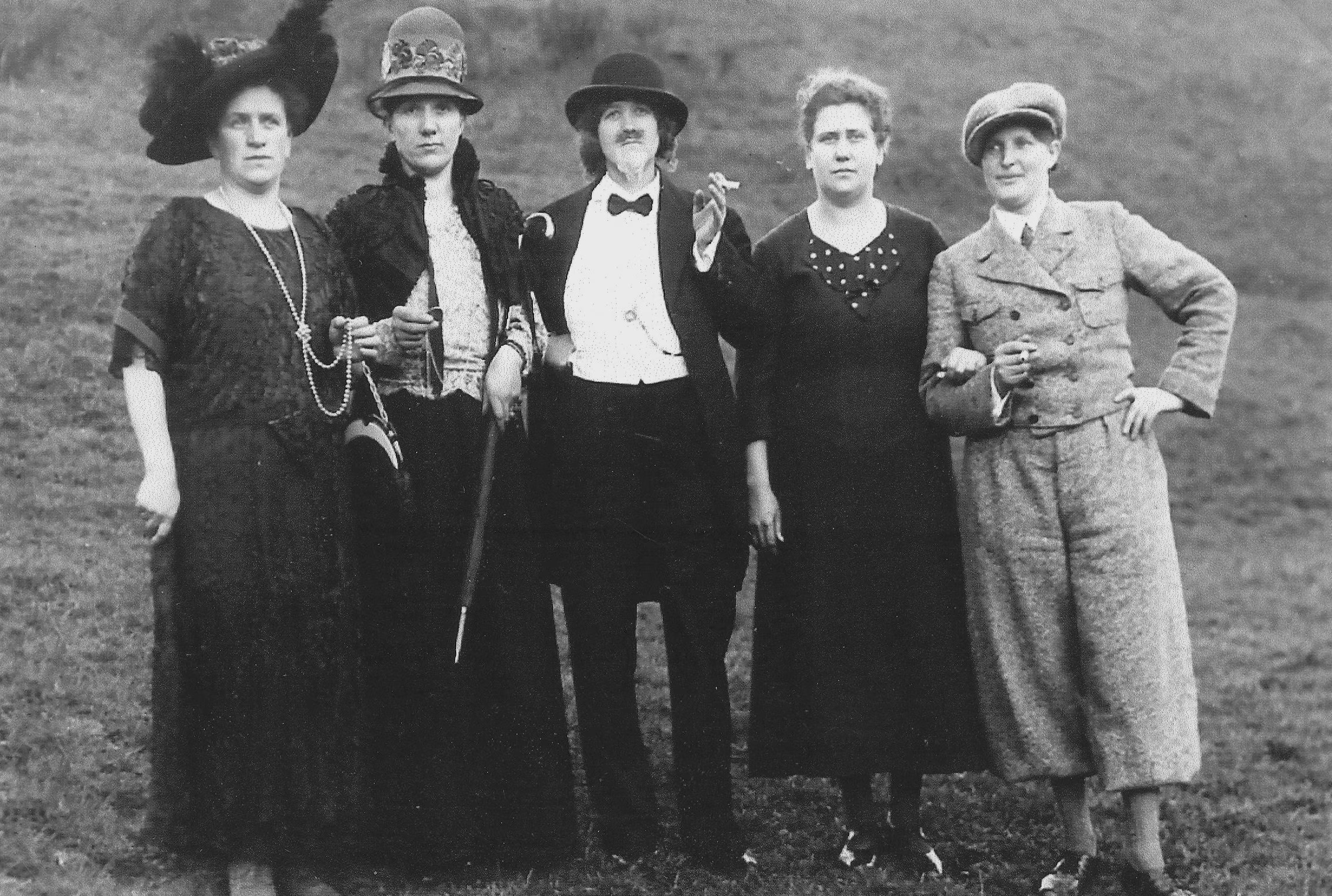
But was the founding of the Women's Aid Association also the beginning of women's work? Joachim Conrad, pastor of the Kölln parish and church historian, knows all the available data and facts. However, they are rather sparse for the period before the Second World War. "Unfortunately, almost everything was destroyed," he laments. He suspects that the Walpershofen Women's Aid already existed before 1924 because traces of an active club life can be documented for this year. Thus, he states: "This year we are celebrating the first documented mention."
A good reason for a house visit with two veterans of women's work in the Köllertal. Brunhilde Sander and Ingrid Siegwart sit at the table in the "good room" at Sanders' in Walpershofen. In fact, both could be celebrating a double anniversary with the association, as they have been board members of the Women's Aid Walpershofen for around 50 years.
Sander, born in 1942, has led the association as chairwoman since 1978 and had previously been active in the women's aid for a long time. She still clearly remembers the year 1971, when the women of Walpershofen elected a proper board of directors for the first time. Until then, there were only delegates for the district association, the so-called district women. The organization of the meetings was often taken over by the wife of the respective parish priest. However, the then priest Matthäus pushed for the board election, and so it happened that Brunhilde Sander was first elected treasurer and a few years later chairwoman.
With the restructuring, the women's aid organization had effectively taken wing. "In the past, women were just passive recipients from the pastor's wife and didn’t dare to say anything," Siegwart also emphasizes. With Brunhilde Sander at the helm, a different era began. "We were encouraged to participate." She liked that and it laid the foundation for her many years of commitment. Because the fact that she even joined the women's aid was initially less due to her own inclination and more due to local traditions. "I never knew what to make of it, but my mother-in-law said: 'You are married now, so off to the women's aid you go.'" Like many others, Siegwart went along, that was in 1975, at the age of 26, and was promptly elected secretary, "because no one else wanted to." She could never have dreamed that she would hold the office continuously until today. This is owed not least to the good cooperation on the board. "There was never any conflict all those years," they say, she and Sander. That way, "women" could fully focus on their substantive ideas.
The work of the women's aid group essentially had two main focuses. On the one hand, there are the regular group meetings held to this day, which include devotion, music, as well as coffee and cake. The center of attention is a discussion about changing topics, preceded by reading stimulus texts. These can be church-related or spiritual topics; sometimes the discussions became political, but always related to women and their lives. Example: the topic of warfare. "People always say they want peace, but it doesn't exist," said Sander. But how does one behave as a mother when children play war? This way, interesting conversations arose again and again. Today, these meetings take place in the Protestant community house in Walpershofen; in the early years, they were sometimes held in private homes as well.
The second focus was always on charitable work. With numerous creative activities, but especially from 1984 onwards with large community festivals, money was raised in support of church and diaconal work. "Without the women's aid group, the church in Walpershofen would not have been built," emphasizes Pastor Conrad. This project, a church of its own for the Riegelsberg district, is also believed to have been the reason for the founding of the local women's aid association, the church historian suspects. In any case, several large bazaars in support of the construction of the church consecrated in 1929 are documented, as well as later actions for renovation – and the anecdote that the "women's aid men, prompted by their wives," even once climbed the scaffolding at the church and scraped the plaster off the facade.
The egg collections at Easter in support of the former Holzer orphanage (now a youth center of the Diakonie) were also legendary. "We collected 600 to 700 eggs in the pram and brought them there," recalls Sander.
Most recently, in the 2010s, the Women's Aid managed to generate a profit of 56,000 euros in favor of the renovation of the Protestant community center Köllertal. It is therefore understandable that Pastor Conrad holds great appreciation for the ladies of the association. “The Women's Aid used to be the driving force of community life,” he says.
Despite all the efforts, there was always time left for shared leisure activities. There were theater performances and fashion shows throughout the years. And the women of Walpershofen did not stay at home. The distance regularly enticed them with day trips or multi-day journeys, which are fondly remembered many years later, for example to Lake Chiemsee (1978), to Central Germany (1996), or to Berlin (2000). “We were in high spirits,” Siegwart recalls joyful bus rides and wonderful experiences.
Currently, the Frauenhilfe Walpershofen consists of 56 female members, in addition to twelve men as supporting members. How it will look in a few years is uncertain. "We are a dying breed," regrets Siegwart. If the current board cannot or does not want to continue their work in the foreseeable future, the association will probably come to a halt, as there are no successors. But for now, the anniversary is to be celebrated with all comrades.
