

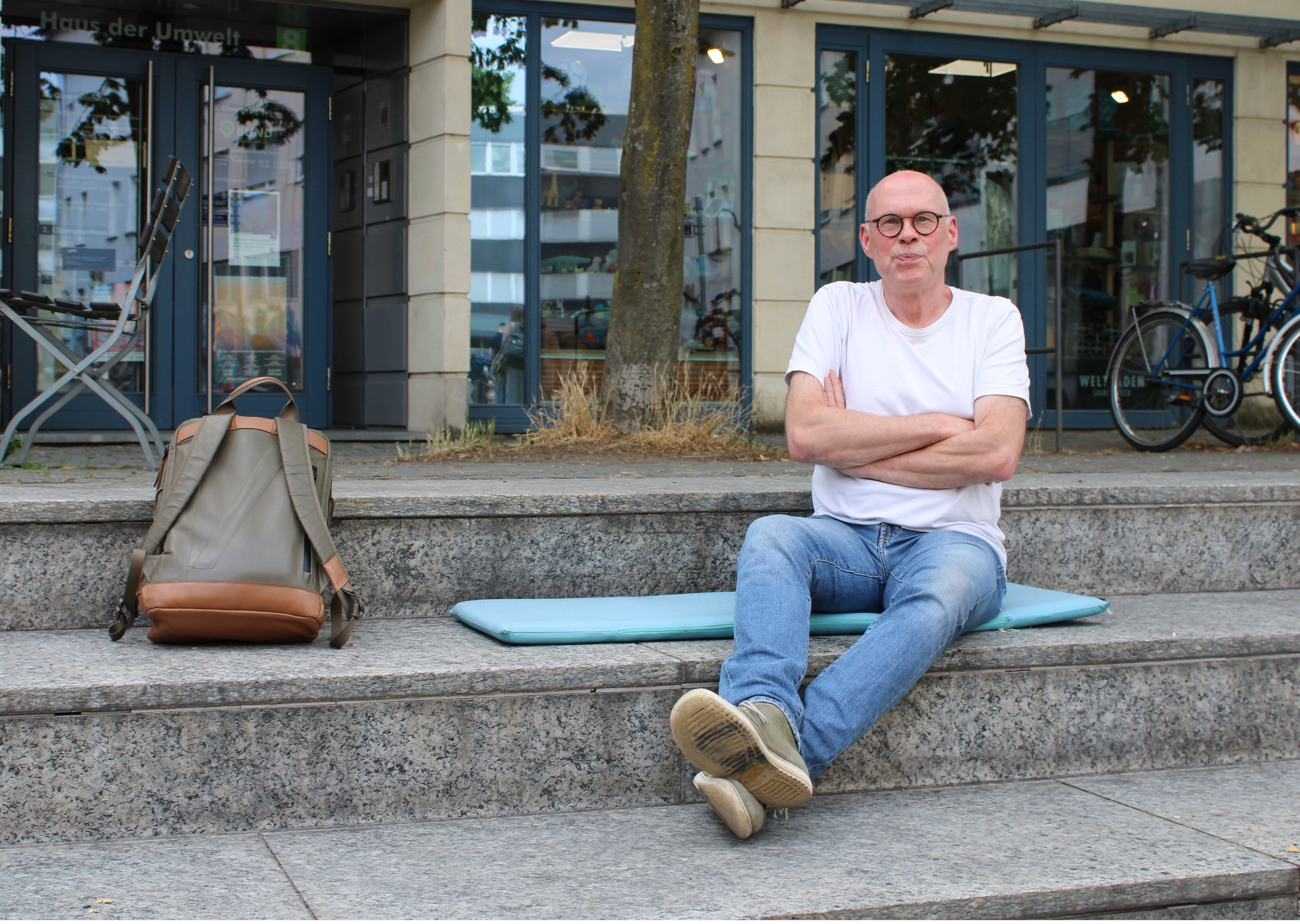
Pastor Rudolf Renner has taken on many tasks throughout his professional life. Behind it always stood the question: How can the church be close to the people? Now he is retiring at the end of the school year. Most recently, saarland.de he served as a Protestant school pastor at the Willi-Graf-Gymnasium in Saarbrücken. July 20, 2026
Raised as the son of a pastor and later superintendent in the Lutheran regional church of Hanover in the south of Lower Saxony, he experienced the full range of church offerings from an early age. Already in the 10th grade at the gymnasium, he knew that he wanted to become a pastor like his father. Nevertheless, after graduating from high school, he did not go directly to university. “I wanted to be officially registered as a conscientious objector,” Renner explains why he first completed his alternative civilian service. Because at that time, aspiring pastors were generally exempt from military service. He then completed his studies in Bethel, Tübingen, and Hamburg, where he also took his first theological exam. He especially remembers the weekly seminars that he was allowed to attend at the Ecumenical Institute in Bossey near Geneva. “I was totally impressed by the exchange with people from all over the world,” he still enthuses today.
[advertisement placement="medium_rectangle" align="left"]At the end of the 1980s, during the so-called “pastor surplus” times with a significant oversupply of pastors, it was not easy for young graduates. Renner was lucky: friends of his parents from Dresden arranged him a job at the Protestant Academy in Meissen after his first state exam. Thus, during these nine months in 1990, he unexpectedly became a contemporary witness of the political turnaround. “I received my first salary still in East German marks,” he recounts. It was also a formative time personally for Renner. The Protestant Church, with its important role in the democratization processes of the GDR, was in a mood of awakening at that time. This impressed Renner. In 1991, he officially transferred from the Hanoverian regional church to the Saxon regional church, completed his practical pastoral training there, and settled down.
After his marriage and the birth of his two sons, he took over a pastoral position in Dresden with his then wife in 1999. Just one year later, a catastrophe occurred that would shape his further professional life. During the centennial flood in Dresden and the surrounding area, he started emergency pastoral care, established close contacts with the emergency services, especially the police. Over the years, this work became his special focus. When his marriage broke up in 2010, Renner knew it was time for a professional change. However, it took a few more years until he happened to see the job advertisement for the position of state police chaplain in Saarland. “I had never been to Saarland before, but I knew: this is exactly what I wanted to do,” he recalls.
[advertisement placement="medium_rectangle" align="right"]Thus, in 2015 in Saarbrücken, he took on half a position each as police chaplain and school pastor at the Marienschule – and felt from the start that he was in the right place. Because in Saarland, he was able to work where he had wanted to be for a long time: “in real life,” outside the church’s internal structures. He learned to appreciate many things in these fields of work: the openness and commitment of the police personnel, the good ecumenical cooperation with Catholic colleagues in the police and school, and especially the religious education, which was equally challenging and fulfilling. “Pastoral care as medium-term relationship work has a special significance here,” he says. Especially younger people without church ties sometimes needed encouragement. It was also important to him to keep the connection of his work to the church alive. One of his highlights was therefore the “Blue Light Church,” which was jointly organized in 2016 as part of the Night of Churches Saar by various emergency services.
Now Rudolf Renner has been released and farewelled during a school church service of the Willi-Graf schools. He already has some plans for his retirement. In addition to his service, he rediscovered his interest in ecumenical relations through partnership work of the then Saar-West church district with Goma in Congo. He wants to continue living in Saarland but can imagine supporting churches in an African country for several months within the framework of a “Senior Expert” program of the United Evangelical Mission. “Preferably in a country with German historical ties,” he says, because the topic of colonialism and its consequences has always interested and accompanied him. In addition, he would like to remain active in the field of emergency pastoral care.
