

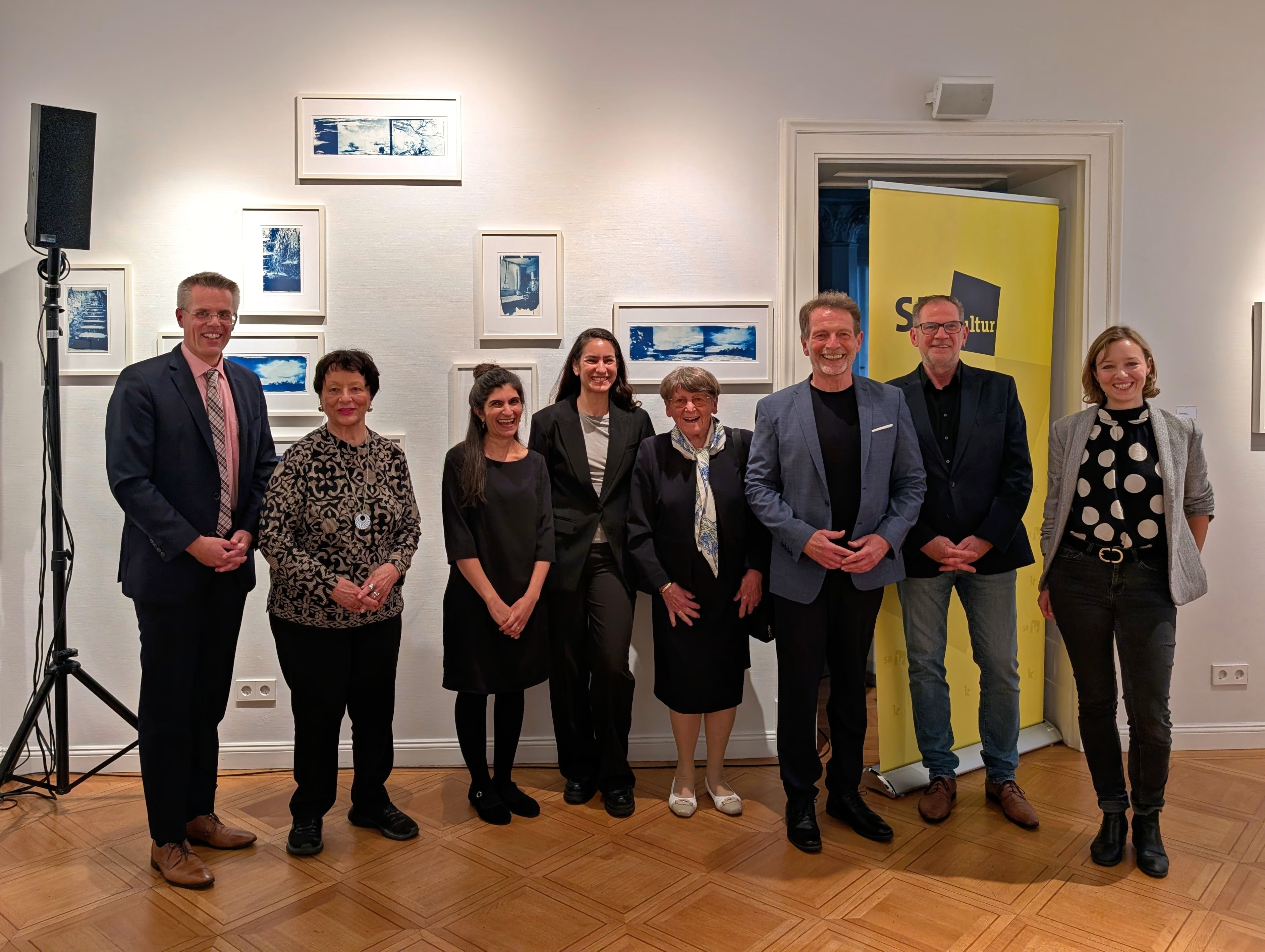
Gustav-Regler Awards 2026 Presented at Fellenberg Castle On Friday, June 12th, the district town of Merzig and the Saarländischer Rundfunk hosted the ceremonial presentation of the Gustav-Regler Awards at the Fellenberg Castle Museum. Sponsored by the Ministry, the two literary prizes have been honoring the work and memory of the Merzig writer Gustav Regler for 30 years. The main prize recognizes outstanding literary contributions to international and intercultural understanding, while the promotional prize supports the voices of young talents. The Gustav-Regler Main Prize 2026, endowed with 10,000 euros, was awarded to the Czech-German writer, publicist, and literary historian Alena Wagnerová. The Saarländischer Rundfunk honored Maryam Aras with the Gustav-Regler Promotional Prize and a prize money of 4,000 euros for her essay "Dinosaurierkind." Both authors share with the memory of Gustav Regler a reflection on humanity beyond national borders as well as a nuanced examination of commemorative cultures rooted in personal or familial exile experiences and the resulting ruptures in (family) biographies. Musically, the award ceremony was accompanied by Nino Deda. Throughout the evening, Mr. Deda delighted the audience with his performances on piano and accordion, providing a harmonious transition between program items. Mayor Marcus Hoffeld was pleased to welcome all guests to the tenth presentation of the Gustav-Regler Awards together with Sonja von Struve, Program Director of SR. Reflecting on Gustav Regler’s political work, Mr. Hoffeld urged that now more than ever it is necessary to actively support democracy and oppose the spread of inhumane ideologies. Literature plays an important role in promoting judgment, empathy, and courage. In the district town of Merzig, people of all generations and regardless of origin demonstrate this attitude—through interfaith cooperation, the network of "Courage Schools – School Without Racism," or through active exchange with German and international partner cities. Marcus Hoffeld and Sonja von Struve expressed their thanks to, among others, District Administrator Daniela Schlegel-Friedrich as the host, the Ministry of Education and Culture represented by Jörg Sämann, the jury, and the family members of the Regler-Repplinger family for the good cooperation. Further thanks were extended to the library team led by Anja Schoppe, Heike Wagner from the Department for Social Affairs and Family, as well as SR’s literary editor Tilla Fuchs for organizing the event. Sonja von Struve joined these greetings, emphasizing that literature can take on a cross-border function in the tradition of Gustav Regler. As Homi K. Bhabha describes in "The Location of Culture": through the encounter of multiple cultures, something new emerges; a fertile space that counters polarization. This "third space" of new understanding is reflected both in Saarland as a border region and in the biographies of this year’s awardees. Jörg Sämann conveyed congratulations on behalf of the Saarland Ministry of Education and Culture and was also pleased to attend due to his affinity for Merzig and Gustav Regler. He had already participated in the first awarding of the Gustav-Regler Prize 30 years ago. As a southern Saarlander, he wished those present the traditional greeting "Glück auf." The writer Shida Bazyar gave the laudation for Maryam Aras and heartily congratulated the awardee. Ms. Bazyar highlighted Maryam Aras’s fearlessness and "unwavering literary compass." Guided by this moral compass, the author does not shy away from deviating from expected paths and illuminating uncomfortable truths. In the words of Gustav Regler, Germany remains a "beautiful and strange country" in need of thinkers like Maryam Aras. The speaker described reading Aras’s works as "a moment of relief and relaxation." The essay "Dinosaurierkind" is a "literary act of fairness" toward Aras's father, who, like many of his fellow exiled Iranian students, protested against the regime of Shah Mohammad Reza Pahlavi and fought fascist structures throughout his life. Yet neither he nor his companions entered German historiography, while the German student movement was celebrated as the intellectual victor. Aras’s biographical tracing of her father connects her to the political developments of the era and the process of historical examination. With a fragile yet radical narrative voice, justice becomes not only the goal but also a stylistic device of the text: Aras’s father engages in a dialogue with his daughter through self-written comments, questioning, correcting, or reflecting on what has been written. In her emotional thank-you speech, Maryam Aras took the opportunity not only to raise her own voice but also to lend an ear to other liberation movements by performing a version of the originally Chilean liberation anthem "El pueblo unido." Aras described herself as "the child of a lifelong fighter," and receiving the Gustav-Regler Promotional Prize means being part of a piece of anti-fascist literary history. She found parallels in the struggles of her father, Gustav Regler, and Alena Wagnerová and questioned the meaning of the "two sides" of a conflict. Not everyone has the privilege of choosing a side. She herself, as the political daughter of her father, has only limited choices: in a reality where her mere existence is political and right-wing extremist ideologies are gaining strength. Maryam Aras concluded her thanks with a call to the attendees: "If you can—choose your side wisely." Peter König honored the life and work of Alena Wagnerová in the second laudation of the evening. He summarized key milestones that led Wagnerová to her own distinctive perspective—against the backdrop of the Nazi regime, exile, and displacement. For the writer, literature in the sense of the Gustav-Regler Prize is both testimony and responsibility: a "commitment to truthfulness," as Gustav Regler wrote in "The Ear of Malchus." Like Maryam Aras, Wagnerová does not shy away from uncomfortable truths and works with precision, courage, and great linguistic discipline. Wagnerová primarily builds bridges: bridges between past and present, between perpetrators and victims, between guilt and suffering. She looks into deep abysses to address and reconcile the interconnections of German, Czech, and Jewish commemorative cultures. The focus is never on abstract history but on concrete fates and ruptures in individual biographies caused by experiences of violence or coercion. Her ideology is wholly devoted to empathy without revising history or relativizing the truth. Moreover, Wagnerová endeavors in her literary work, as well as on radio and podcasts, to amplify biographies with marginalized voices—such as the writing of a biography of Milena Jesenská: a brilliant and intelligent journalist historically reduced to the role of Franz Kafka’s lover. According to Peter König, Wagnerová’s biography contributed to freeing Jesenská’s work from the shadow of a famous man. Last year, Alena Wagnerová celebrated her 90th birthday, and Mr. König expressed thanks on behalf of the Gustav-Regler Prize jury for the author’s lifelong achievements. In her thanks, Alena Wagnerová also did not put herself at the center but emphasized the values and guiding principles of her literary work. When writing about the biographies of others, one must not think too much about oneself. A quote from Gustav Regler resonates especially as a life philosophy in connection with the award: "We are all human"—and that is what matters most. Furthermore, words hold the power to be used either as a means of truthfulness or as a weapon to be misused. Finally, Mayor Hoffeld thanked all participants and invited guests to conclude the evening with a small reception, drinks, and conversations. For those seeking further insights into the award ceremony, SR Kultur will broadcast a recording of the reading by both awardees in conversation with SR literary editor Tilla Fuchs as part of the series "Literature in Conversation" on June 24, 2026, at 7:15 pm. Additionally, the jury’s full statements can be found on the district town of Merzig’s online press release portal (https://www.merzig.de/rathaus-buergerservice/pressemeldungen/).
Cross-border literature Language and responsibility Culture in conversation with Tilla…
Tags:
