

35 years of the German-Polish Neighbourhood Treaty:
Saarpfalz district celebrates the anniversary with international exchanges
A historic milestone is marking its 35th anniversary these days: On June 17, 1991, then Federal Chancellor Helmut Kohl and the Polish Prime Minister Jan Krzysztof Bielecki, together with their respective foreign ministers, signed in Bonn the "Treaty between the Federal Republic of Germany and the Republic of Poland on Good Neighbourliness and Friendly Cooperation." After the deep wounds of the Second World War and the fall of the Iron Curtain, this historic agreement laid the legal and political foundation for lasting reconciliation, close partnership, and peaceful coexistence in the heart of Europe. The treaty not only secured minority rights and the inviolability of borders but above all opened the doors for intensive cooperation at regional and local levels, which has since formed the true core of the German-Polish friendship.
As a region located directly on the French-German border, the Saarpfalz district early on understood the power of reconciliation and international friendship. Since the 1990s, the district has maintained intensive international contacts and has continuously expanded its network of partnerships. Originating from the first contacts and cultural exchanges of the association "Meetings at the Border" and the youth exchanges at Spohns House, the focus of the German-Polish cooperation is the deeply rooted, oldest partnership of the Saarpfalz district with the district of Przemyśl (Carpathian Foothills Voivodeship). This year, the Saarpfalz district proudly celebrates the 15th anniversary of this close connection.
This long-standing partnership work, which in the spirit of the "Weimar Triangle" also builds a bridge between France, Germany, and Poland, has been coordinated and brought to life from the very beginning by Dr. Violetta Frys, head of the Europe unit and Europe representative of the Saarpfalz district, with great commitment. Dr. Frys was originally hired by the then district administrator Clemens Lindemann specifically to promote German-Polish cooperation and continuously expanded the district partnerships under his successor Dr. Theophil Gallo as well. The current district administrator Frank John now looks back on a stable foundation of citizen-focused projects that Dr. Frys continues to carry out for the district.
How vibrant, professionally profound, and future-oriented this German-Polish spirit is in the anniversary year 2026 was recently demonstrated during the Europe Week of the Saarpfalz district. The collaboration always connects the historical heritage with the most pressing issues of the present. Together with international partners, core topics such as the cooperation of biosphere reserves, the future of elderly care, the economic situation, and the protection of public services facilities were discussed. The highly topical issue of cybersecurity was also intensely examined during an appointment with the CISPA Helmholtz Center for Information Security.
How concrete the mutual benefit is was also demonstrated by a workshop organized in May at the district administration on the topic "Emergency Protocol System for the Saarpfalz District and the Municipal Administrations" by the Polish consulting company JP Weber. Here, very recent, painful but valuable experiences from the Ukraine war were also incorporated. The presented system for the rapid recording and management of crisis situations met with great interest from the districts for future crisis preparedness.
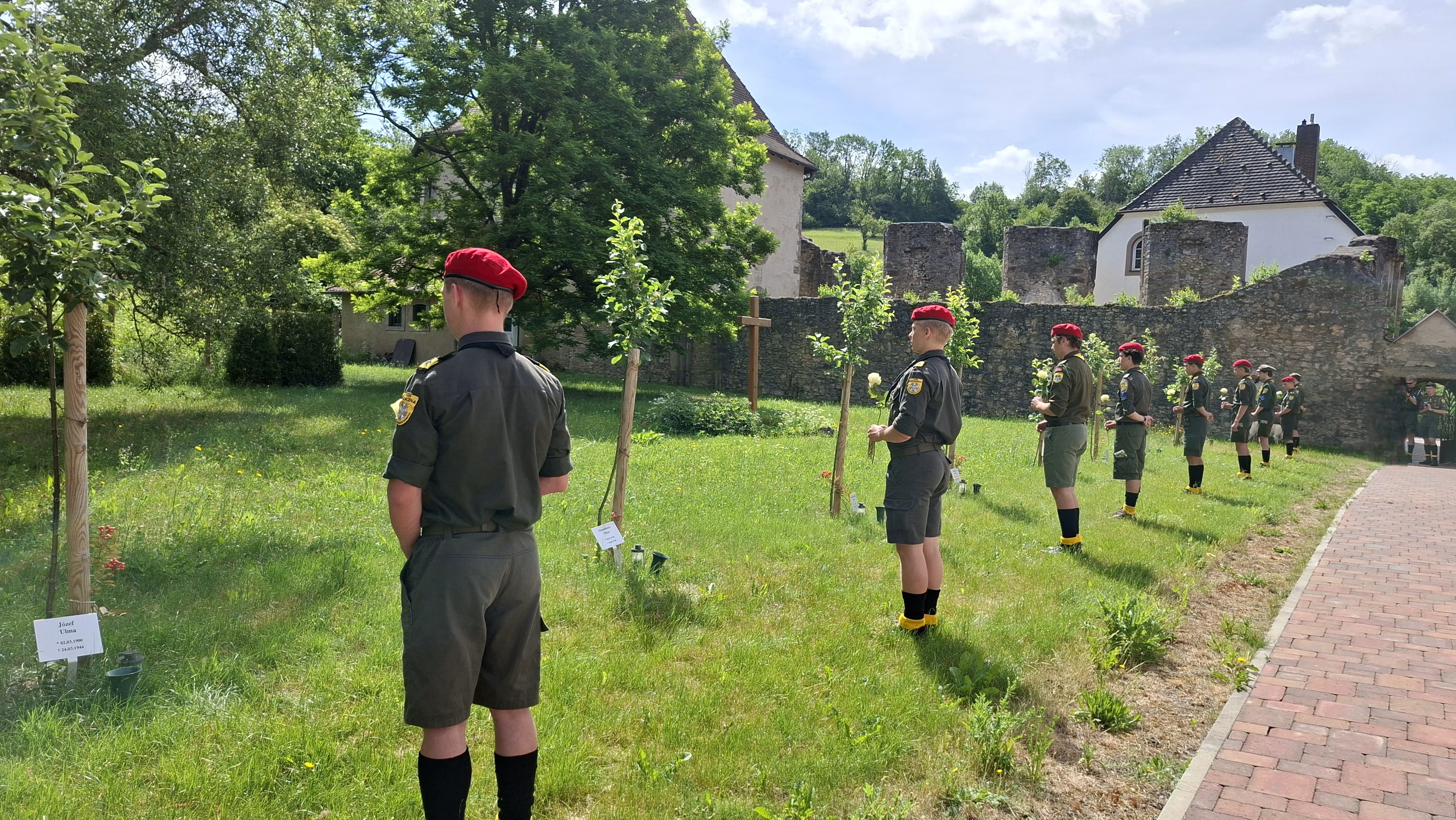
That the German-Polish cooperation bears fruit not only on the administrative level but also among citizens was demonstrated by the subsequent youth encounter in the district: An eleven-member group of young scouts from the Polish ZHR association of the partner district Łańcut (also in the Carpathian Foothills Voivodeship) traveled to St. Ingbert for a five-day visit to the St. Ingbert Mitte scouting association.
Only at the end of September last year did the chairmen of DPSG St. Ingbert Mitte, Stefan Gress and Christian Klein, sign a letter of intent to promote youth exchange during an official delegation trip of the Saarpfalz district in Łańcut, Poland. Thanks to the mediation of District Administrator Frank John and his Polish counterpart Adam Krzysztoń (Łańcut district) as well as financial support from the Union Foundation Saarbrücken, the German-Polish Youth Office together with the non-profit Sanddorf Foundation Regensburg, this agreement was now implemented in record time.
Together with their German scouting colleagues, the young people explored the European border region under bright sunshine. The program included visits to the UNESCO World Heritage site Völklinger Hütte, the Carreau Wendel in neighboring France, as well as the monasteries Gräfinthal and Blieskastel. In addition to an official reception at the St. Ingbert town hall, a tour of the Becker Tower, and a themed afternoon at the Rohrbacher Mill, social highlights such as a visit to the outdoor swimming pool and the obligatory "sausage stop at Schleppi" were not to be missed.
Throughout the entire project initiation and execution, Dr. Violetta Frys actively supported the scouting associations. As a native Pole, she also provided linguistic assistance at the meeting – during which she made a very important observation: "It is fascinating to see how the language barrier between the young people has virtually shrunk by the minute. English now serves as a completely natural bridge for the younger generation to immediately start conversations. But the most beautiful thing is the mutual respect for each other's language: many young Polish individuals are learning German with great dedication, and on the other hand, we are seeing more and more Germans wanting to learn Polish. Important structures have already been created to meet this demand. When language is no longer an obstacle but a tool of curiosity, then that is lived Europe at its best."
At the farewell, it was clear: this meeting was just the beginning. A return visit by the St. Ingbert DPSG scouts to the Łańcut district was already arranged for the coming summer at the invitation of Wojciech Trawka and Kacper Sawicki, the two leaders of the Polish scouts. The established contacts are to be deepened sustainably and in the future also lead to very personal meetings outside of organized programs.
For District Administrator Frank John, this project exemplifies what the 35th anniversary of the neighborhood treaty is all about at its core:
“A contract on paper is the foundation, but it is the people – especially the youth – who bring the German-Polish friendship to life. When young people discover commonalities and form friendships across borders, that is the European future in the most beautiful sense.”
Information about the district partnerships and the European work of the Saarpfalz District are available from the head of the Europe department, Dr. Violetta Frys, by phone at (06841) 104-8273 or via the email addresses europa@saarpfalz-kreis.de as well as violetta.frys@saarpfalz-kreis.de.
-------
Photo 01: Dr. Violetta Frys
The Polish scouts laying flowers at the memorial of the blessed Ulma family at the Gräfinthal monastery
Photo 02: Dr. Violetta Frys
The Polish, German, and French scouts in Parc Explor Wendel in Petite-Rosselle
Photo 03: Danuta Frys
The Polish and German scouts at the Blieskastel monastery
In the photo (from left): Stefan Gress, Dr. Violetta Frys, Wojciech Trawka, Dominik Gress as well as Father Hieronim Jopek (center) and Kacper Sawicki (1st from right)
------
