



Issued on: 10.06.2026
Press Release 88/2026
Strengthening tourism and the national park region – the state is investing more than
4.7 million euros in KELTENPARK Otzenhausen
The State Secretary in the Ministry of the Interior, Building and Sports, Torsten Lang, handed over two grants totaling 541,778 euros for the National Park Gate KELTENPARK visitor center to the municipality of Nonnweiler and the district of St. Wendel during an on-site appointment on May 21.
“The Celtic Park is an outstanding project of great importance for the entire region. With the visitor center, a modern and attractive place of encounter and information has been created, which makes the national park tangible and at the same time sustainably strengthens tourism development. For this reason, Saarland has also put together an extensive funding package for this nature and cultural tourism important project,” explained State Secretary Torsten Lang at the handover ceremony.
State Secretary Elena Yorgova-Ramanauskas: “Those who visit the Hunsrück-Hochwald National Park from Saarland will encounter the national park gate Keltenpark, a place that combines nature experience, education, and regional identity. The distinctive visitor center symbolizes the close cooperation across state borders and vividly brings to life the natural and cultural history of the Hunsrück-Hochwald. At the same time, the national park gate strengthens Saarland’s tourist appeal and underlines the importance of the national park as a shared natural heritage of the region.”
Financial support has already been provided in the past by the
Ministry of Economic Affairs, Innovation, Digitalization and Energy within the framework of the ERDF program "Operational Program ERDF Saarland 2014-2020" amounting to around 8.6 million euros. This sum consists of EU funds amounting to 4,611,916.92 euros, a state share of co-financing funds amounting to 2,614,714.16 euros, as well as state funds from the special Future Initiative fund of 1,399,109.95 euros.
The remaining municipal share of approximately 1.08 million euros was borne equally by the district of St. Wendel and the municipality of Nonnweiler. The total cost of the project amounted to around 10.4 million euros.
In addition, the Ministry of Environment, Climate, Mobility, Agriculture and Consumer Protection funded the National Park exhibition "Natural, with History!" set up in the visitor center with 260,000 euros.
„The Hunsrück-Hochwald National Park combines nature and history of our region. This is also reflected in the exhibition,“ says State Secretary for the Environment Sebastian Thul. „Here you can embark on a journey into the past, admire cultural-historical relics from the time of the Celts and Romans up to the recent history, and playfully learn at interactive stations how we benefit from the forest today, which animals and plants find a habitat here, and how we can protect it.“
The exhibition
was also financially supported by the German Federal Environmental Foundation and the Zweckverband Nationalpark-Tor Keltenpark. Itfollows the red thread "From the primeval forest through human-influenced natural and cultural landscapes back to a new wilderness" over a total of 300 m².
The official inauguration ceremony of the visitor center took place in early November 2023, and the exhibition was opened with the start of the season in April 2024.
Mayor Franz Josef Barth: "The National Park Gate Celtic Park is a significant milestone for the municipality of Nonnweiler and the entire region. With the visitor center, a modern place has been created that uniquely combines nature, history, and tourism. It strengthens our position as an attractive gateway to the Hunsrück-Hochwald National Park, creates added value for both guests and locals, and sets important impulses for the sustainable development of our community. My thanks go to all partners and sponsors who contributed to the successful implementation of this project."
Martina Weiand, Deputy of the Sankt Wendel district: “The Keltenpark Gate is one of the cultural and tourist highlights of our district. It addresses nature, culture, and people, the three most important resources of our region. Thus, the Keltenpark Gate appeals to both our many visitors and the citizens of our district – and they all learn interesting and new things about our impressive nature and the national park as well as about our Celtic heritage. Worthwhile, sustainable, educational.”
Modern inviting information and meeting place for the sustainable strengthening of the tourism infrastructure
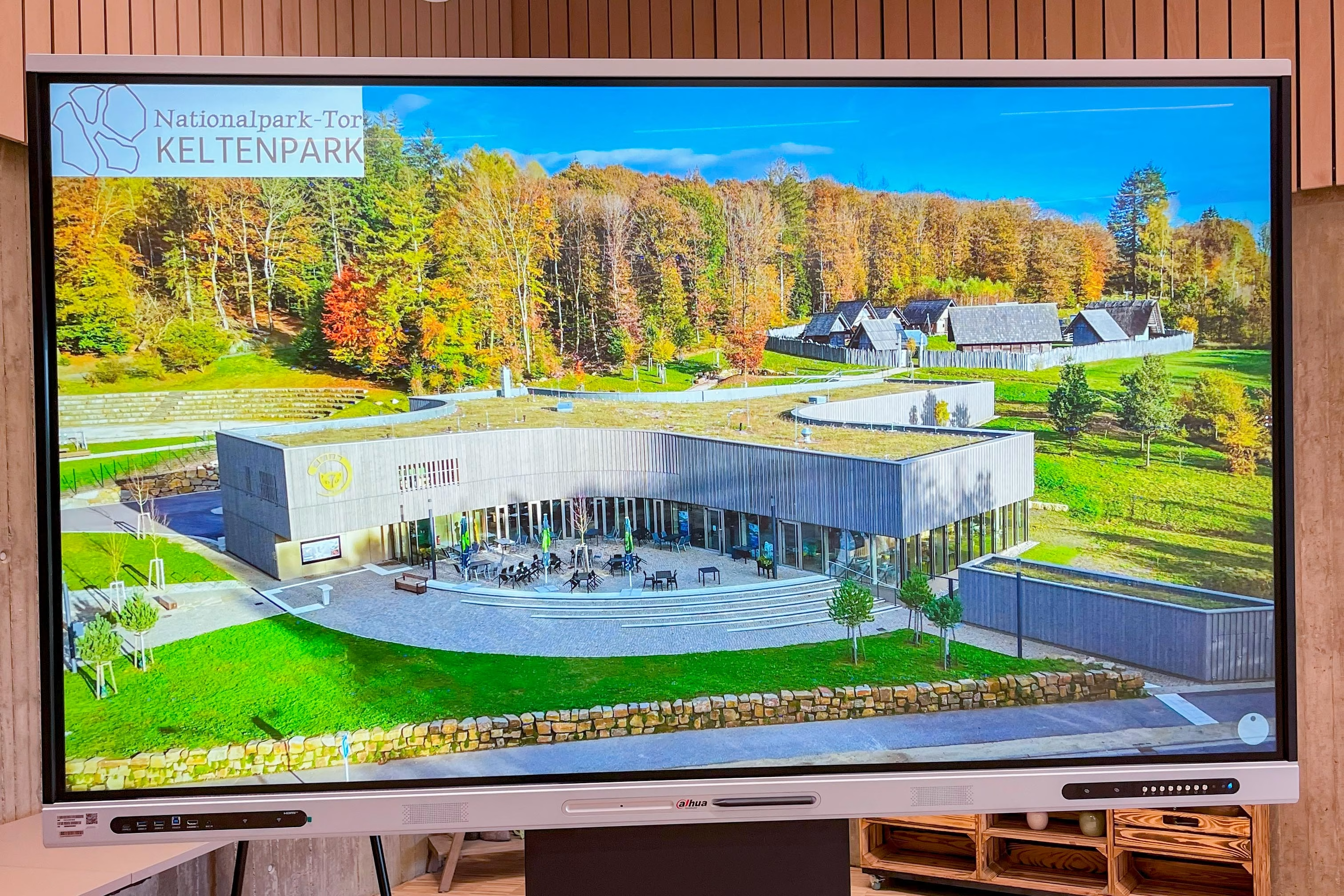
The visitor center serves as the Saarland gateway to the Hunsrück-Hochwald National Park and an important point of contact for visitors, uniquely combining nature experience, tourism, and cultural heritage. Guests can find information there about the guiding principles for the park's creation as well as the fauna and flora of the national park, and also about the Celtic-influenced history of the region. The new building houses the following areas:
This is a joint project; the sponsor and operator is the Zweckverband Nationalpark-Tor Keltenpark, consisting of the district of St. Wendel, the municipality of Nonnweiler, and the Saarland, represented by the Ministry for Environment, Climate, Mobility, Agriculture, and Consumer Protection.
Background
The Keltenpark area is located north of Nonnweiler-Otzenhausen and serves, together with two other facilities, as a national park gate to the Hunsrück-Hochwald Nature Park. The cross-state Hunsrück-Hochwald National Park in Rhineland-Palatinate and Saarland was opened in 2015. It is the first national park in Germany to be established from the outset across state borders.
Together with the existing arena and the Celtic village established in 2011, the visitor center forms the third core area that needed to be connected with the other two. The characteristic cross shape of the building allows for a differentiation of the individual open spaces, each of which has thus gained its own unique character.
The National Park Gateway Keltenpark in Nonnweiler was constructed as a new build and serves as an important component in the cross-border overall concept of the national park.
Image source: MIBS/F. Färber.
