

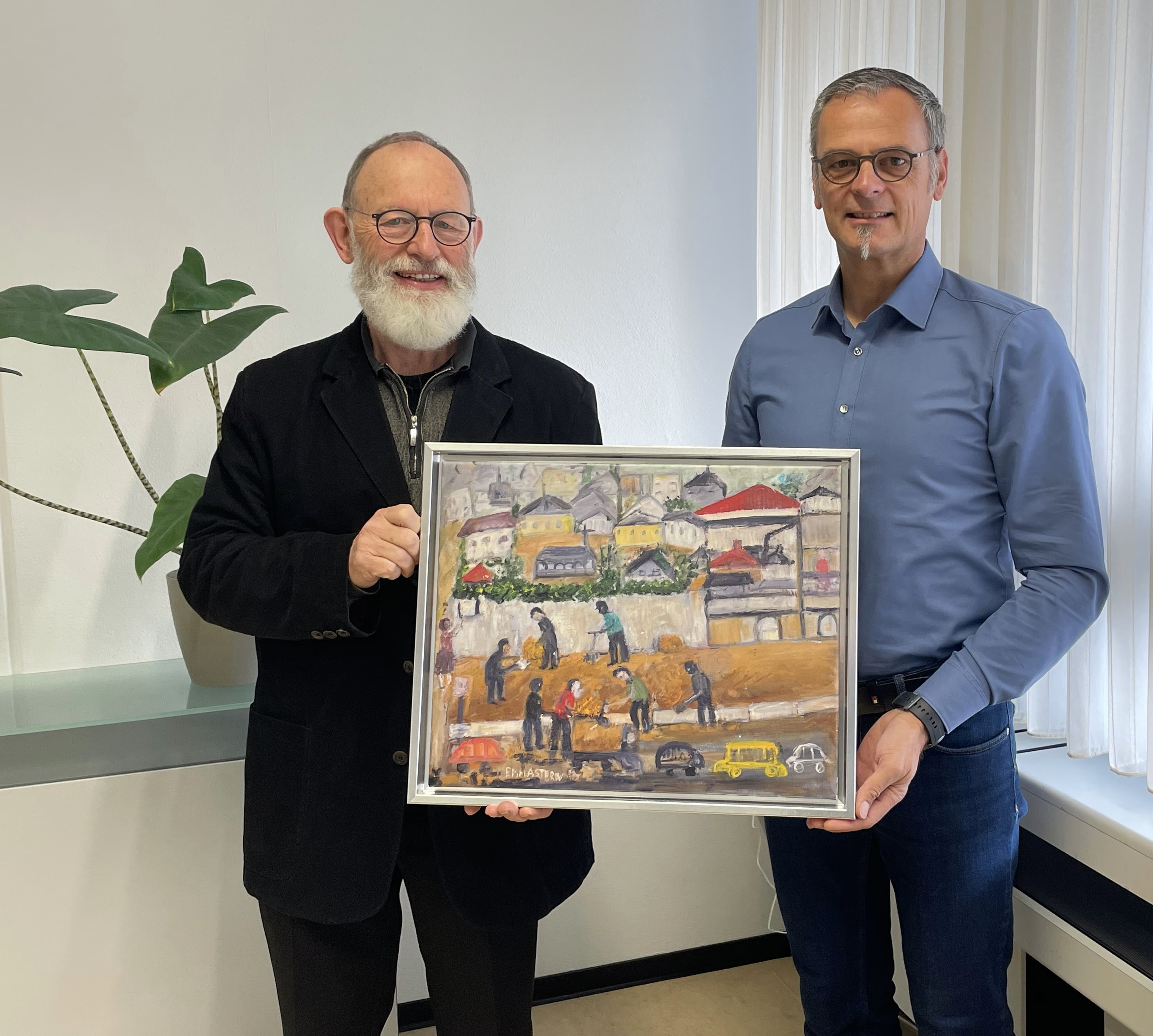
Emma Stern is considered the most important German painter of "naive art." She was born in 1878 in St. Wendel and married Julius Stern in 1896. Together they ran the department store "S. Daniel, owner J. Stern" in Lebach's Marktstraße – a business that was of considerable importance in Lebach.
During the Saar referendum, Emma and her sons opposed the Third Reich and therefore had to flee into exile in France in 1935, where they lived under false names. Emma Stern, Ruth Stern, and Kurt Stern survived the war, while Paul Stern was murdered in Auschwitz.
Emma Stern only began painting at the age of 70. Her paintings were almost coincidentally noticed by the highly renowned painter Dubuffet, who immediately included the works in an exhibition in Paris. Within a short time, Emma Stern became known and recognized as a painter of "naive art." She painted about 500 paintings until her death at the age of 91, which were displayed in museums and exhibitions in France and Germany or are on permanent view.
Emma Stern never had an artistic or even academic formal education. She created from within herself, following her own impulses. The paintings mostly have a flat composition; spatial perspective plays no role, and figures are simply placed above or beside each other.
The painting owned by the city of Lebach is likely from the 1960s. It shows an everyday scene, construction workers busy working on a road. Cars are naively only suggested, houses or roofs form an architectural ensemble that cannot be assigned to any specific city: A scene that could take place anywhere and thus can claim universality both thematically and through the style of its naive execution.
In Lebach, due to urban development since the 1950s, there are no longer any traces of the former Jewish families. Therefore, the picture of Emma Stern is an important testimony in Lebach's history. The picture is the only currently available image of Emma Stern.
Mayor Brill thanked for the elaborate reproduction and assured that the picture will be displayed in a special place so that it is accessible to as broad a public as possible.
