

The SAK serves information, education, coordination, and lobbying work in poverty policy. It works on issues, problems, and solutions for children, adolescents, adults, families, seniors, and groups affected by poverty or living in poverty, thereby experiencing social, economic, or cultural disadvantage.
The SAK develops approaches to overcoming poverty and focuses its actions on the implementation of social participation. It sees itself as the statewide counterpart to the "National Poverty Conference".
In the city of Saarlouis, which was already awarded for its family-friendliness in 2001, a Local Alliance for Families was established in July 2006. Together, the numerous guests at the founding event affirmed their commitment to continue working within the alliance to promote a social climate where families and children are welcome. From the very beginning, enabling participation for people was essential. Thus, the city council introduced the Family and Social Pass as a means of social participation, as well as the diaper subsidy as social policy instruments.
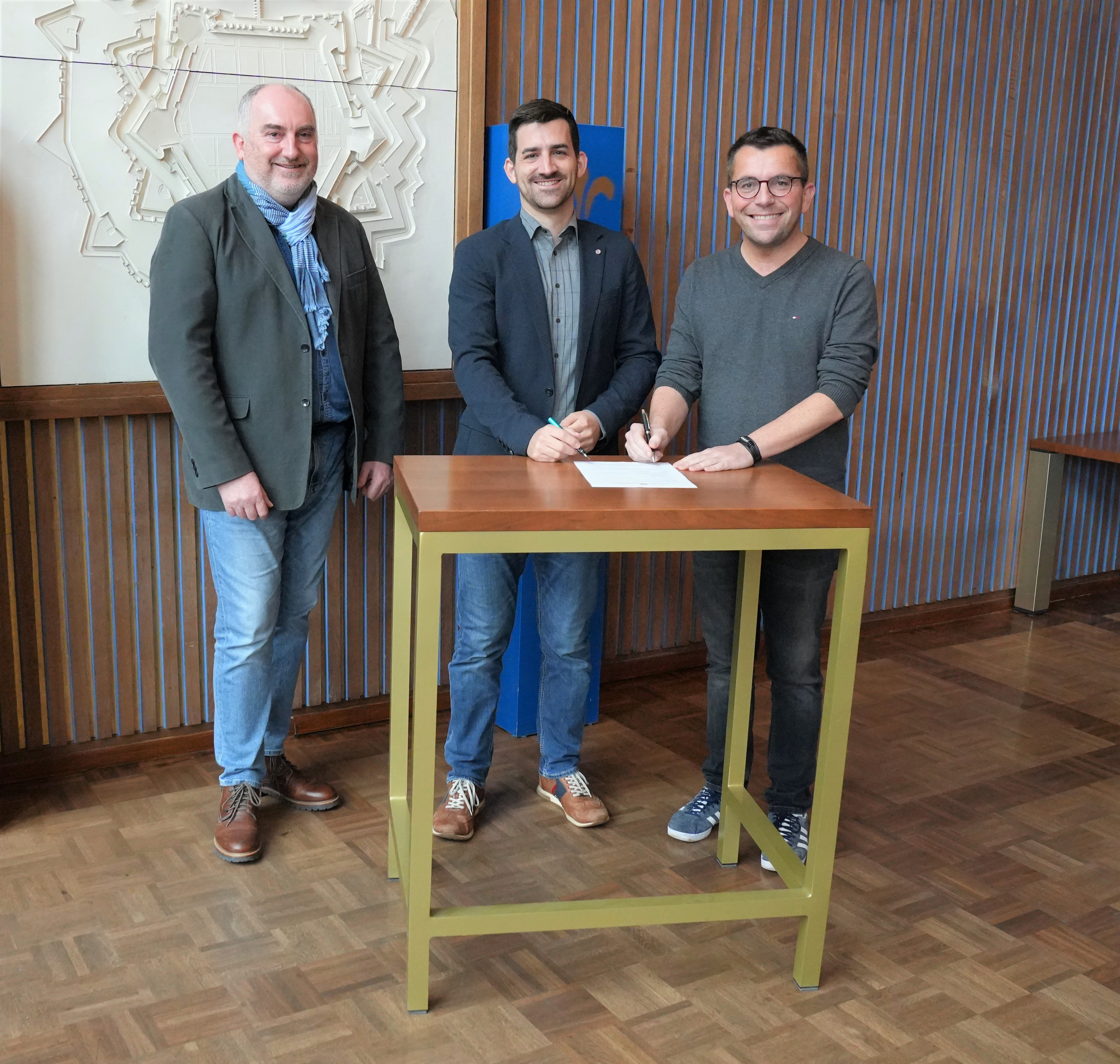
“With the establishment of the social cohesion areas and the associated BIWAQ projects in Roden and Fraulautern, we have created projects specifically for people with experiences of poverty. In addition, special offers such as the social department store or the OASE are supported by the district town of Saarlouis. Especially through the BIWAQ projects and the social department store, we not only create participation but also concrete opportunities for integration into the labor market. In this way, we offer people of working age perspectives to overcome poverty in the long term. Therefore, it was a logical consequence for us to join the Saarland Poverty Conference. For the district town of Saarlouis, Mayor Carsten Quirin will take over the representation,” said Lord Mayor Marc Speicher.
In order to meet its responsibilities and to "give a voice to poor people," the SAK is represented in various networks, committees, and advisory boards. It enables the development and further elaboration of specialist topics in poverty policy as a network with interested parties in its own working groups.
As part of its public relations work, SAK prepares position papers and statements, drafts press releases, and serves as a contact for the press.
The SAK is supported by individual members, organizations, institutions, social associations, political parties, trade unions, and municipalities.
The Saarland Poverty Conference is funded by grants from the Saarland Ministry of Labour, Social Affairs, Women and Health, contributions from cooperation partners, membership fees, as well as donations.
