

Knockout drops, abbreviated as KO drops, are drugs that have a narcotic effect but can also lead to unconsciousness and death. They are administered unnoticed in drinks or food, making them barely detectable by taste or smell. The effect is devastating: 15 to 30 minutes after ingestion, the affected person usually feels nauseous and dizzy. The victims are helpless and defenseless. Under the influence of KO drops, there are often cases of rape, sexual harassment, and robbery. Upon waking up, victims experience memory gaps or have no recollection of what happened. Especially young women are often victims of assaults linked to KO drops. Many victims are unsure about what really happened and hesitate to seek help.
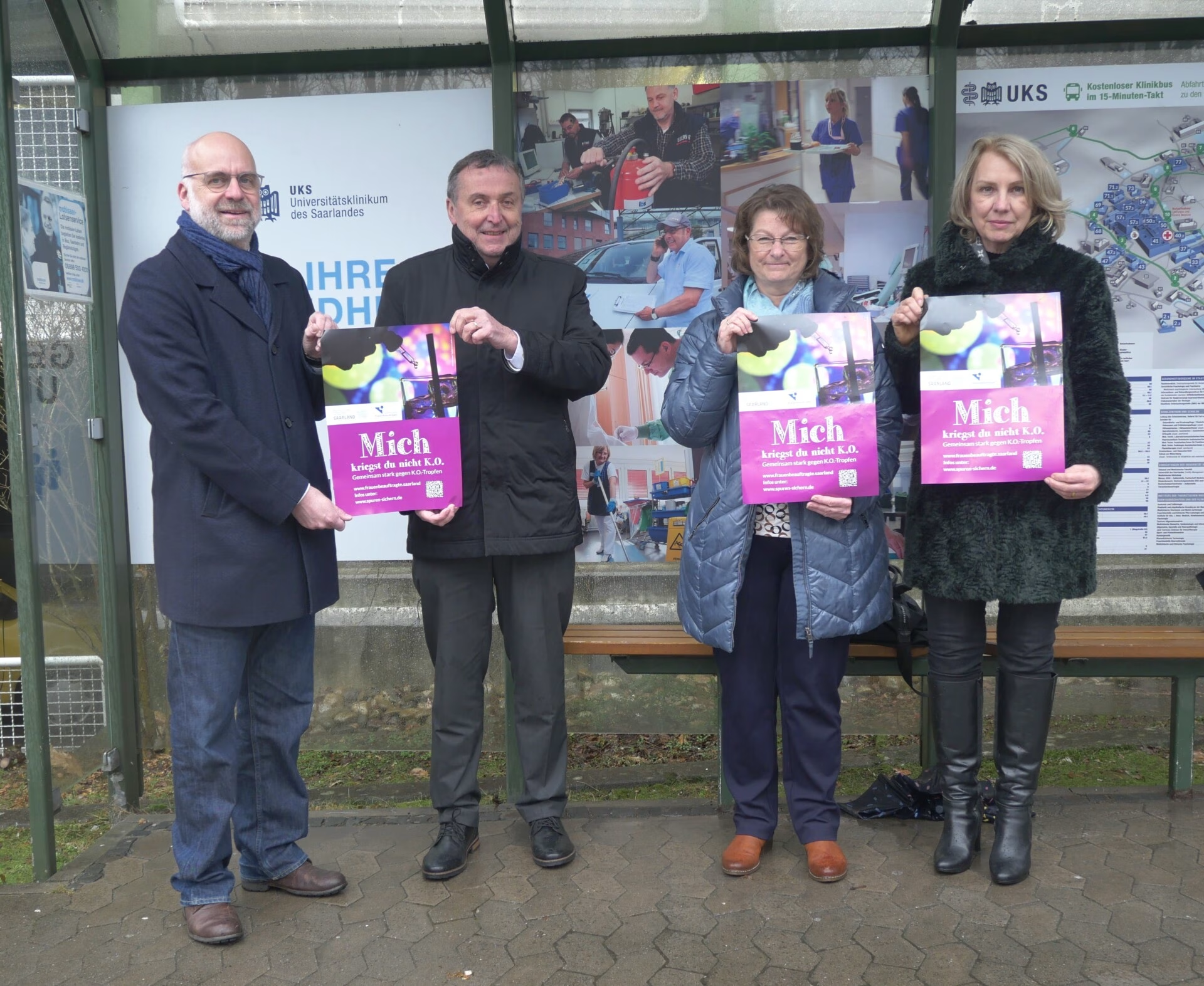
This is where the prevention work of the campaign "You won’t knock me out! – Together strong against knockout drops!" begins. It was developed by the Ministry of Labor, Social Affairs, Women and Health of Saarland, as well as the State Working Group of Municipal Women's Officers, in collaboration with specialized counseling centers for sexual violence Nele, Phönix, Women's Emergency Call, and the White Ring. The campaign raises awareness of the danger through statewide visible bus advertising, citylight posters, and educational efforts with mobile action teams active in discos, clubs, and city festivals. Flyers and posters are also distributed in authorities and schools. Recently, the municipal women’s officers of the district town of Homburg and the Saarpfalz district presented the bus wrapping at the Homburg University Clinics.
“The action teams raise awareness for mindful, preventive behavior. This includes, for example, not accepting open drinks from strangers or leaving drinks unattended. At the same time, they provide tips for suspected cases. An interesting addition is a knockout drug testing wristband that detects the dangerous substance within two minutes,” explains Anke Michalsky, women's representative of the district town of Homburg. There is no specific statistic in Saarland on cases involving knockout drugs. These cases are related to sexual offenses and/or deprivation of liberty. For Birgit Rudolf, women's representative of the Saarpfalz district, it is clear: “Both the substance itself and the victims’ memory gaps make the crimes difficult to prove and therefore hard to prosecute. This makes it easy for the perpetrators. The consequences for those affected are very distressing and traumatizing. It is a terrible thought to become a victim of a knockout drug attack.”
"Currently, there is no club and disco scene in the district town. Pubs are more popular. This does not mean that we can turn a blind eye. Young people visit clubs and discos in the surrounding area or attend our city festivals as well as the St. Nicholas and Christmas markets throughout the year. I am grateful to the municipal women's representatives for this initiative," said Mayor Michael Forster. District Administrator Dr. Theophil Gallo urges people to seek help but also to report to the police: "It is distressing to have to relive the experience during police interviews and to initiate legal steps. But only in this way will it be possible to hold perpetrators or registered repeat offenders accountable. From my conversations and appointments with the Saarpfalz police, I can say that there are police officers who are sensitive and empathetic in their care."
„A large proportion of people who have fallen victim to drink spiking are reluctant to seek help. One problem here is that many are uncertain about what really happened,“ said State Secretary for Women Bettina Altesleben. „As the high number of unreported cases and the low use of medical and psychosocial support by victims show, raising public awareness of the issues of drink spiking and sexual violence is particularly important.“
The goal of the campaign, which is linked to the state campaign "Sexual violence leaves traces," is to raise awareness of the dangers resulting from the administration of so-called knockout drops. At the same time, strategies are presented that enable individuals to better protect themselves and others. With a video clip that can be shared via various social media channels, the campaign aims to particularly reach young people and raise awareness about the issue (https://www.facebook.com/soziales.saarland/posts/5479988765438656).
“Through the campaign, we also want to encourage victims of sexual violence to seek help and to take advantage of confidential immediate medical assistance, which we have been offering in Saarland since 2014 with confidential evidence collection after sexual violence. To this end, we provide corresponding services nationwide in clinics and specialist medical practices throughout Saarland,” said State Secretary Bettina Altesleben.
If there is suspicion that oneself or another person has become a victim of a knock-out drug, those affected should have blood and urine samples taken as soon as possible in a hospital, along with the associated documentation. Even if someone has not (yet) decided to press charges, it is important to confidentially secure samples, findings, and photos of injuries for a possible criminal proceeding.
Information on confidential evidence preservation after sexual violence:
In order to improve the medical care of victims of sexual violence and to enable them access to a "procedure-independent" evidence collection, the state government, in cooperation with the Saarland Women's Emergency Call and other partners, has introduced a procedure for confidential evidence collection after sexual violence: affected victims of sexual violence who are not immediately able to decide on filing a criminal complaint have the opportunity, with confidential evidence collection, to have the traces of the violent act securely preserved for court even without a police report. This provides them access to an offer that gives them the possibility of making a self-determined decision – for or against an (immediate) complaint – as well as time and space to cope with their difficult situation.
The service is free of charge for those affected and can be accessed in Saarland both in selected clinics and in private practices. On the website www.spuren-sichern.de and by calling (0681) 844 944, those affected can find out around the clock where the confidential support service can be used. They also have the opportunity here to learn about the procedure and the contact details of counseling centers near their place of residence.
Help and counseling services for women, as well as children and adolescents, affected by domestic and/or sexual violence
Women’s Emergency Call Saarland Tel. (0681-36767) Email: notrufgruppe-sb@t-online.de www.frauennotruf-saarland.de
Nationwide helpline for violence against women Tel. (0800) 116016 www.hilfetelefon.de
Police emergency number 110
Nele - Counseling against sexual exploitation of girls Tel. (0681) 32043 Email: nele-sb@t-online.de www.nele-saarland.de
PHOENIX - Advice against sexual exploitation of boys Tel. (0681) 7619685 Email: phoenix@lvsaarland.awo.org
Counseling and intervention center for victims of domestic violence Email: interventionsstelle@skf-saarbruecken.de www.skf-saarbruecken.de Tel. (0681) 3799610
White Ring LV Tel. (0681) 67319 Email: Saarland@weisser-ring.de SOS CHILD PROTECTION and Counseling Saar Tel. (0681) 9365275 Email: kd-saarbruecken@sos-kinderdorf.de
ALDONA e.V. - Counseling Center for Migrant Women Email: Aldona-ev@t-online.de www.aldona-ev.de Tel. (0681) 373631
Intercultural counseling for women by women Tel. (0681) 373535 or (0681) 40 14 76 50 Email: info@beratung-interkulturell.com, www.beratung-interkulturell.com
Crisis hotline and counseling for (imminent) forced marriage 0 800 – 16 11 111 (free of charge); Online counseling: http://www.zwangsheirat-saarland.de/
