

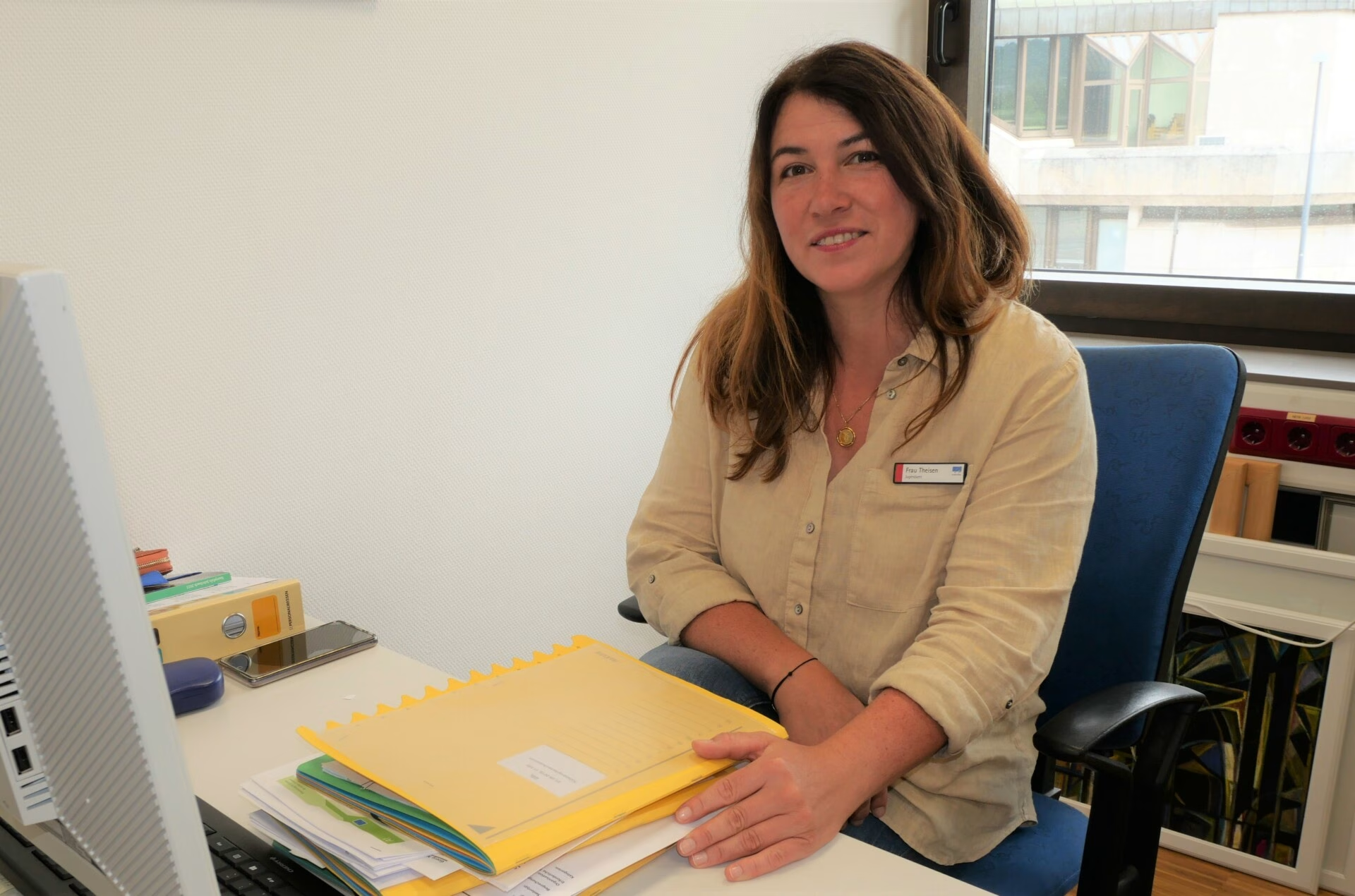
Katja Theisen has been working at the Youth Welfare Office of the Saarpfalz district for 15 years. Far from the clichéd "woman from the youth welfare office," the committed graduate social pedagogue portrays a picture of her valuable work with families, children, and adolescents.
As a certified nurse, she previously gained extensive experience with people in crisis situations, including patients as well as their relatives. Her supportive approach encouraged her to switch to social work.
Her exact professional field today is the "District Social Service," which includes the core tasks of a youth welfare office. Theisen's daily duties include, among other things, advising families and children, for example in cases of separation and divorce, as well as handling reports of child welfare endangerment and their investigation. Additionally, she is also responsible for coordinating assistance and participating in family court proceedings.
The fact that the term "youth welfare office" carries a rather negative connotation does not exactly make Katja Theisen's work easier. "Negative news is, as we know, more attractive. Successes in our work are rarely reported or discussed." Who really wants to have the "woman from the youth welfare office" standing at their door? But when I am with the families on-site and can genuinely help, their reservations quickly disappear. Therefore, I deal with clichés and prejudices calmly," emphasizes the 43-year-old.
When parents and children in the family unit need help, when support in child-rearing becomes necessary, professional advice and care can often lead quite quickly to good solutions for internal concerns and problems. However, every case of care must be considered individually. Which path is the right one in each case is a question that fundamentally demands difficult balancing processes from all social workers in the youth welfare office.
“We discuss individual case decisions within the team to gain a comprehensive understanding and to consider diverse perspectives. This is indispensable for this work. If we reach the irrefutable conclusion that the child's welfare is at risk, then at least a temporary separation from the parents becomes necessary. This is communicated to the families immediately. I try to quickly achieve a consensual understanding with the parents. It is important to convey to them that the goal is always a successful reintegration into the parental household. If this does not succeed, however, we are always interested in maintaining positive contacts between the child and their family of origin,” explains Katja Theisen.
Nationwide, youth welfare offices provided around 963,000 parenting support services in 2020. This is 11 percent more than in 2010. Even during the pandemic, these services were tended to be continued rather than discontinued. Katja Theisen has also observed this development and speaks of an increase in social phobias and depressive moods among children and adolescents over the past two years. She explains this phenomenon of social phobia especially during the pandemic by noting that many already vulnerable children and adolescents, for example due to bullying, who only attended school because of compulsory schooling, then stayed at home for longer periods. Others were often left to themselves at home, which intensified social anxieties, and only the internet was available as a means of communication. Domestic issues, such as parental separation or unemployment, were perceived more intensely as a result and led to an additional burden.
„The challenge in the future will also be to deal appropriately and professionally with such psychological burdens on children and adolescents. Investing in maintaining the quality of youth welfare staff as well as in sustaining and expanding the youth welfare standards will be indispensable,“ Katja Theisen is convinced. And she advocates trust in the youth welfare office: „Parents should feel encouraged to approach us directly if problems arise. Seeking help is not an admission of failure, quite the opposite. It demonstrates good responsibility. Early counseling can, in some cases, prevent the continuation of conflicts. In our youth welfare office, there are trustworthy and competent professionals who, depending on the individual situation, offer counseling services or refer on.“
Katja Theisen takes great joy in her work despite the high demands of child protection. She describes herself as a resilient and fundamentally optimistic person who knows how to switch off privately and ensure a proper balance after work, the graduate social pedagogue openly shares. Clearing her head is certainly possible even in the morning when she cycles to work through the beautiful Beeder Bliesauen on her racing bike.
