

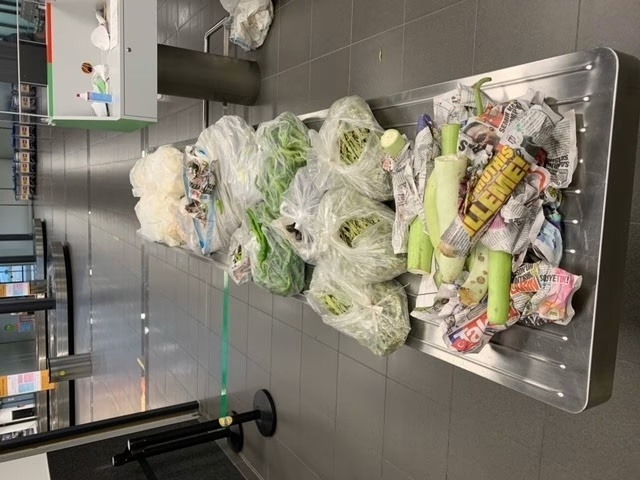
Saarbrücken (ots) - During checks of arriving passengers at Saarbrücken Airport by customs, it was noticed that in recent weeks there had been an increase in seizures of non-permissible food items.
Among other things, the luggage of a family of five was checked upon their entry from Turkey. They had a total of nearly 25 kilograms of food in their luggage. In addition to 5 kilograms of cheese and 4 kilograms of butter, they also carried large quantities of fruits and vegetables. Since there was suspicion of a violation of national and European food laws, the prohibited items were initially confiscated by the Saarbrücken customs and the Saarland Chamber of Agriculture was informed. This body will now decide independently whether the food must be destroyed.
At this point, the State Office for Consumer Protection of Saarland, the Chamber of Agriculture of Saarland, and Customs point out that food products in passenger and postal traffic, especially from third countries, are subject to strict restrictions. For example, foods of animal origin (processed and unprocessed), such as meat, eggs, milk, fish, honey, or butter from third countries – also for animal disease control reasons – must meet the requirements of the EU food hygiene regulations just like foods produced within the community. The import of non-animal foods such as fruits, vegetables, tubers, sprouts, plants for planting, or roots also poses the risk of introducing and spreading diseases and pests. This can cause significant damage to plants and nature in Germany and other European Union countries. For questions related to foods from third countries, you should therefore contact the authorities responsible for food law in good time. In Saarland, these are the Chamber of Agriculture of Saarland and the State Office for Consumer Protection of Saarland. Whether there are restrictions or import bans for certain goods when entering Germany can be found on the information signs at the airport or checked on the go with the free smartphone app "Customs and Travel".
Additional information:
Customs authorities monitor, among other things, the proper importation of food products in both commercial shipments and travel traffic to protect the population. The imported food must be safe, meaning it must comply with European and national legal criteria. In addition to food law regulations, other legal provisions, such as animal disease laws or sanitary plant protection laws, must also be strictly observed. Specific hygiene regulations have been established by the community for products of animal origin, which must be adhered to alongside the general food safety requirements.
What should be considered with animal products from third countries? Animal products can only be given customs clearance once a veterinarian at a border inspection post (so-called border veterinary officer) has checked the required documents and the identity and has conducted a goods inspection. The arrival of a shipment containing animal products must be reported to the responsible border inspection post at least one working day in advance. Furthermore, the import of animal products is only permitted from certain third countries or specific establishments. Additionally, special health certificates, issued on official forms, must be submitted for some animal products from third countries. This applies, for example, to honey and other beekeeping products or certain fishery products.
What should be considered regarding food of non-animal origin from third countries? Plants include all living plants and living plant parts (e.g., fruits, vegetables, cut flowers, tubers, onions, roots, sprouts, seeds (except those not intended for planting), branches with or without leaves, leaves and foliage, buds, top shoots, cuttings). Plant diseases and pests can be introduced with living plants, plant products, or other items that carry certain harmful organisms, or even with adhering soil from abroad. The import of particularly dangerous harmful organisms—and of course also of plants, plant products, and other items that are infested or may be infested with these—is subject to special phytosanitary regulations. Certain plants, plant products, and other items may, for example, only be imported if special requirements (e.g., plant health certificates, import inspections) are met. The importer or a responsible person must notify the respective border inspection post, where the plants, plant products, and other items are to be checked, of the arrival of a shipment before its arrival by submitting a Common Health Entry Document (CHED).
Note
The decision on whether the goods meet the food law and animal health law requirements is, in any case, made by the authority responsible under food law or animal health law.
Detailed information can be found on our website in the specialized topics section at the following link: https://www.zoll.de/DE/Fachthemen/Verbote-Beschraenkungen/ Schutz-der-menschlichen-Gesundheit/Lebensmittel/Allgemeine-Informationen/allgeme ine-informationen_node.html
Website of the State Office for Consumer Protection
https://www.saarland.de/lav/DE/institution/ansprechpartner/ansprechpartner.html
Contact person of the Chamber of Agriculture for Saarland Sabine Gebhard,
Phone: 06826 828 95 47, www.lwk-saarland.de
