

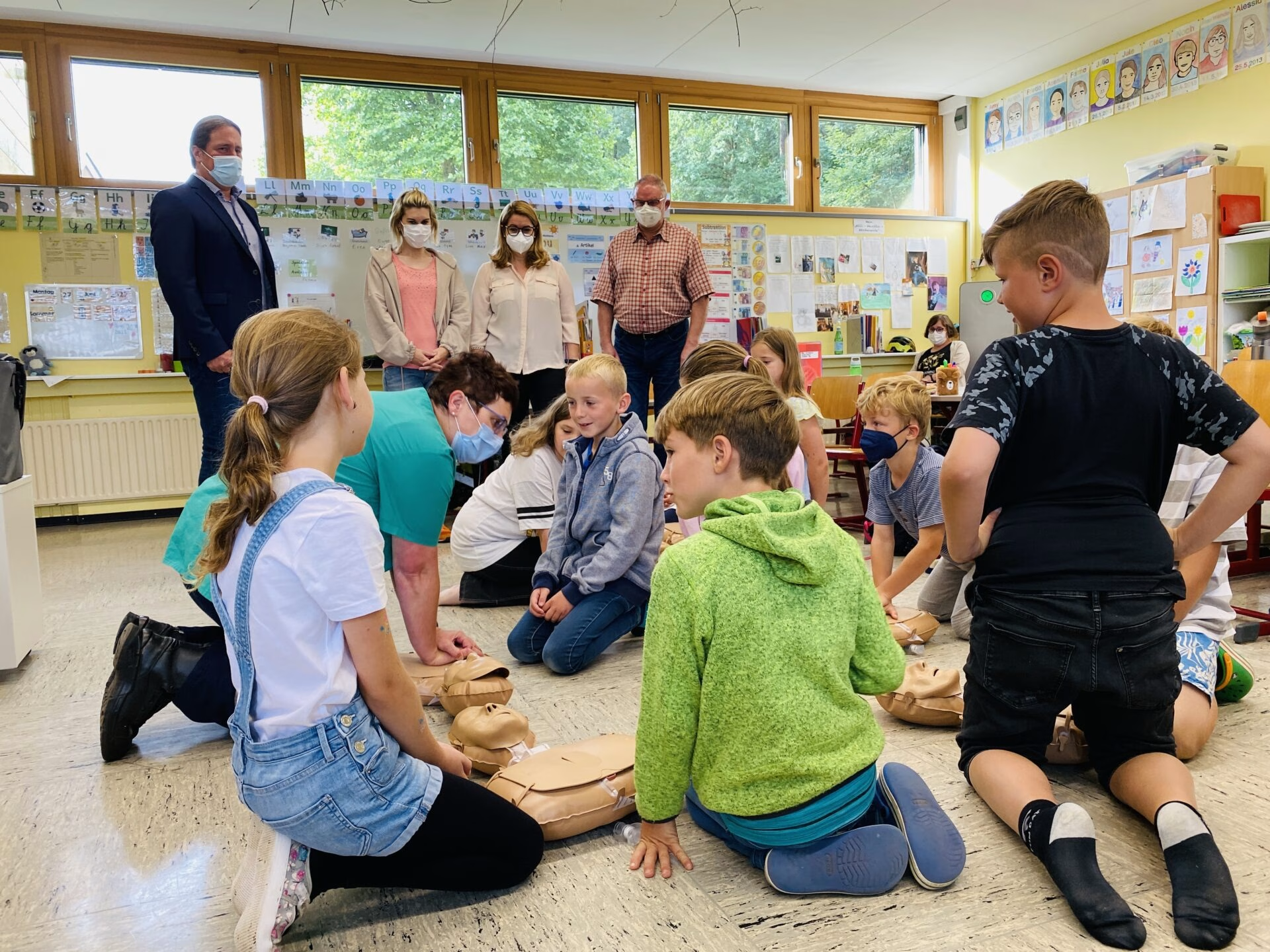
With a loud "boom," Jan falls to the ground. He is a student in class 3c at the Pestalozzi Elementary School, Hassel branch. Jan wants to become an actor and was asked by Dr. Claudia Meyer-Lang to pretend to be unconscious. The reason for this little performance? Dr. Meyer-Lang gently yet memorably explains to the children what to do in an emergency, that is, when they find a lifeless, unconscious person. "How do you recognize if the person is perhaps just sleeping?" she asks. "Right: The first step is 'Check.' Speak to the person, shake them by the shoulder, or pinch their arm. If they move, they are not unconscious." Jan giggles as she shakes his arm. But then it gets serious.
And what if the person doesn’t move? Then comes the second step, which the children already know well: “We call 112, the emergency services!” they shout all at once. “Exactly right! The second step is called ‘Call’,” praises the emergency doctor and chief anesthesiologist at the St. Ingbert district hospital. Then comes the third step: “Press,” and this one isn’t so easy. At some dummies, the children now learn to press hard on the chest rhythmically 100 times per minute for several minutes. Because it can take several minutes for the heart to start beating again and for the brain to be supplied with oxygen. While doing this, they sing the Pippi Longstocking song, helping them perfectly memorize the action and the rhythm. Only when the emergency services arrive are the children allowed to stop pressing.
The project is part of the guidelines set by the German and European Resuscitation Councils. “In recent years, it has become clear that Germany is still a ‘developing country’ in the field of lay resuscitation, as only a small portion of the population knows what to do in the event of cardiac arrest,” explains Dr. Meyer-Lang. “The professional societies are therefore increasingly calling for resuscitation measures to be introduced to primary school students.” She herself came into contact with this project during her time at Saarbrücken Winterberg Hospital and has been carrying her enthusiasm for it forward ever since. Thus, she developed the “Check-Call-Press” (CCP) program and presented it to Mayor and primary school principal Nadine Backes. She immediately promoted it in all of St. Ingbert’s elementary schools. The St. Ingbert District Hospital is also convinced of the importance of the project and funded the acquisition of the necessary practice mannequins. “Thanks to the dedication of Dr. Meyer-Lang and with the support of the city of St. Ingbert, we are exemplary fulfilling the demands of the professional societies together,” affirm Peter Zwirner, Managing Director of the St. Ingbert District Hospital, and Medical Director PD Dr. med. Oliver Adam unanimously.
The project had to be postponed due to the coronavirus but has now been launched at the primary school in Hassel and is offered to all 3rd grades in St. Ingbert. According to the doctor, this makes St. Ingbert, to their knowledge, at least the first municipality in Saarland where all students of a grade level are trained in the topic of resuscitation. "It would be wonderful if it were possible to reach all students nationwide, repeat it in every grade level, and also integrate it into other subjects," hopes the dedicated emergency physician. And she emphasizes with a laugh: "What little Hans learns early on, big Hans will be able to do perfectly!"
“This is really important. And the children have no apprehension at all,” marvels Markus Hauck, local head of Hassel. “Thanks to this program, they will remember the life-saving measures well into adulthood.” Representing Headmistress Nadine Backes, Deputy Head Petra Röser and class teacher Mrs. Engler are present at the first training session as part of the program. Both are pleased that Dr. Meyer-Lang has such a good connection with the children on this important topic.
