

The "Kultur- und Heimatverein Beckingen e.V." and the "Association Fort aux Fresques" Hestroff (F) invite you to a two-day event "Shared Memories – one day in the year 1939" – "Mémoires Partagées – une journée en 1939".
Visitors can explore the Westwall Museum on Pfaffenkopf in Beckingen as well as the small fortress "Bois de Bousse", better known as "Fort aux Fresques" in 57320 Hestroff (F), Rue de la Forêt, about 30 kilometers from the German border. Shuttle buses run between the two locations on Sundays.
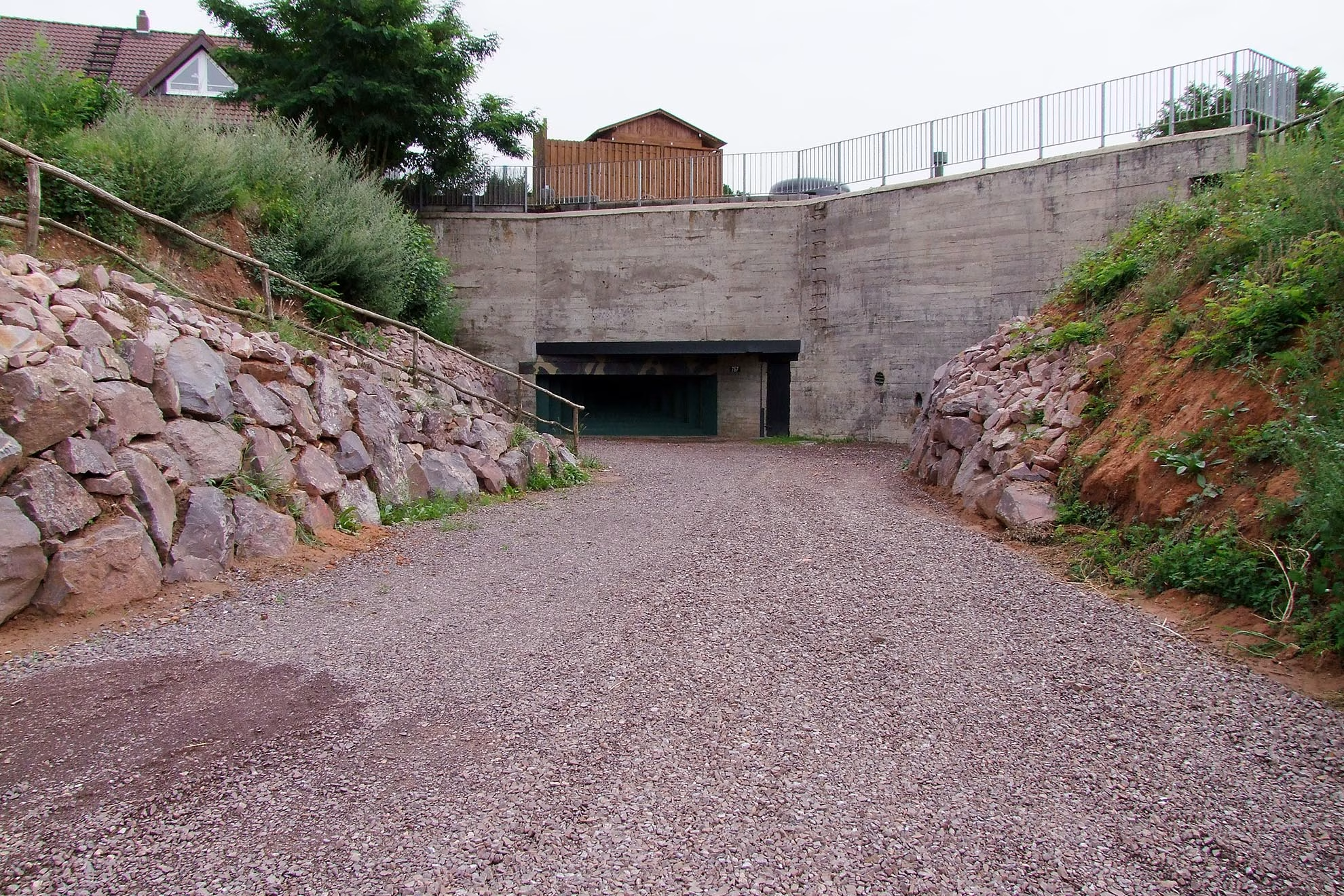
The Westwall Museum on Pfaffenkopf consists of two bunkers: No. 767 "Erlkönig", a standard type 114a, and bunker No. 766 "Sperling", a standard type 2a. The smaller bunker presents the history of the Saarland from 1919 to 1945. The larger bunker, due to its construction with wall and ceiling thicknesses of 3.5 meters, is one of the strongest bunker facilities of the former Westwall. The "Landbefestigung West," known as the Westwall, was built on Hitler's orders from 1936 to 1940. It stretched along Germany’s western border from the Lower Rhine to the Swiss border. This Westwall consisted of about 14,200 structures and many kilometers of tank and infantry obstacles. Of the approximately 14,200 bunkers of various types and construction strengths, about 4,500 were located in the Saarland, 125 of them in Beckingen alone. As a counterpart to the French Maginot Line, it was intended to deter France and England from attacking the German Reich. It was hoped that this would facilitate the conquest of the "living space in the East." Thanks to the commitment of the interest group “Westwall in Beckingen,” a subdivision of the Kultur- und Heimatverein Beckingen, the bunker complex is in very good condition. Guided tours take place every first Sunday of the month from April to October.
The "Petit Ouvrage Bois de Bousse," better known as "Fort aux Fresques" in Hestroff (F), is one of the most interesting installations on the Maginot Line. The "Ligne Maginot" was a defensive system consisting of a line of bunkers along the French border with Belgium, Luxembourg, Germany, and Italy, named after the French Minister of Defense André Maginot. The Maginot Line was built from 1930 to 1940 to prevent or repel attacks from these neighboring countries or from the hegemonic powers Germany and Italy that might attack through their territories.
The bunker installation in Hestroff (F) is also in very good condition thanks to the dedication of the numerous members of the "Association Fort aux Fresques." It is a bunker complex restored with great attention to detail. The small fortress "Fort aux Fresques" owes its name to the numerous drawings and especially its fresco, conceived by Daniel Derveaux, an artist from Saint-Malo, which was created during the "drôle de guerre" (September 1939 to June 1940). The visit allows visitors to explore the infrastructure, the functionality, and the living conditions of the bunker crew.
Program:
On Saturday, May 28, 2022, there will be an official opening program at the bunker site in Hestroff (F) with participants from a delegation of the Beckingen Cultural and Homeland Association.
On Sunday, May 29, 2022, an official part will begin at 11:30 a.m. with political representatives from Bouzonville, Rehlingen, and Beckingen.
On Sunday afternoon from 2:00 p.m., guided tours will take place for the general public at both sites, in Beckingen and Hestroff (F). Shuttle buses will be used. Departure from Beckingen at 2:00 p.m., 3:00 p.m., and 4:00 p.m., including return trips. There is space for 8 people each time. The tours in France will be conducted in German. The tours in Beckingen will be conducted in German and French. Culinary offerings are well provided at both locations. Tours and transport are free of charge.
Registrations with Axel Jungmann, Tel.: 06835/4607 or Horst Schwarzenberger, Tel.: 06835/4681 (both from the Beckingen Cultural and Homeland Association e.V.).
Intent:
"We want to strengthen cooperation between our organizations by organizing this joint event. The idea is to develop a complementary program so that visitors can discover a one-day reconstruction of World War II on both the French and German sides. We want our visitors to immerse themselves in the events of the Second World War simultaneously on the French and German sides. When switching from one site to the other on this day, one learns about both sides of the Franco-German conflict," explains Axel Jungmann, chairman of the Beckingen Cultural and Homeland Association.
This event is funded by the EU funding program INTERREG V A "Greater Region."
