

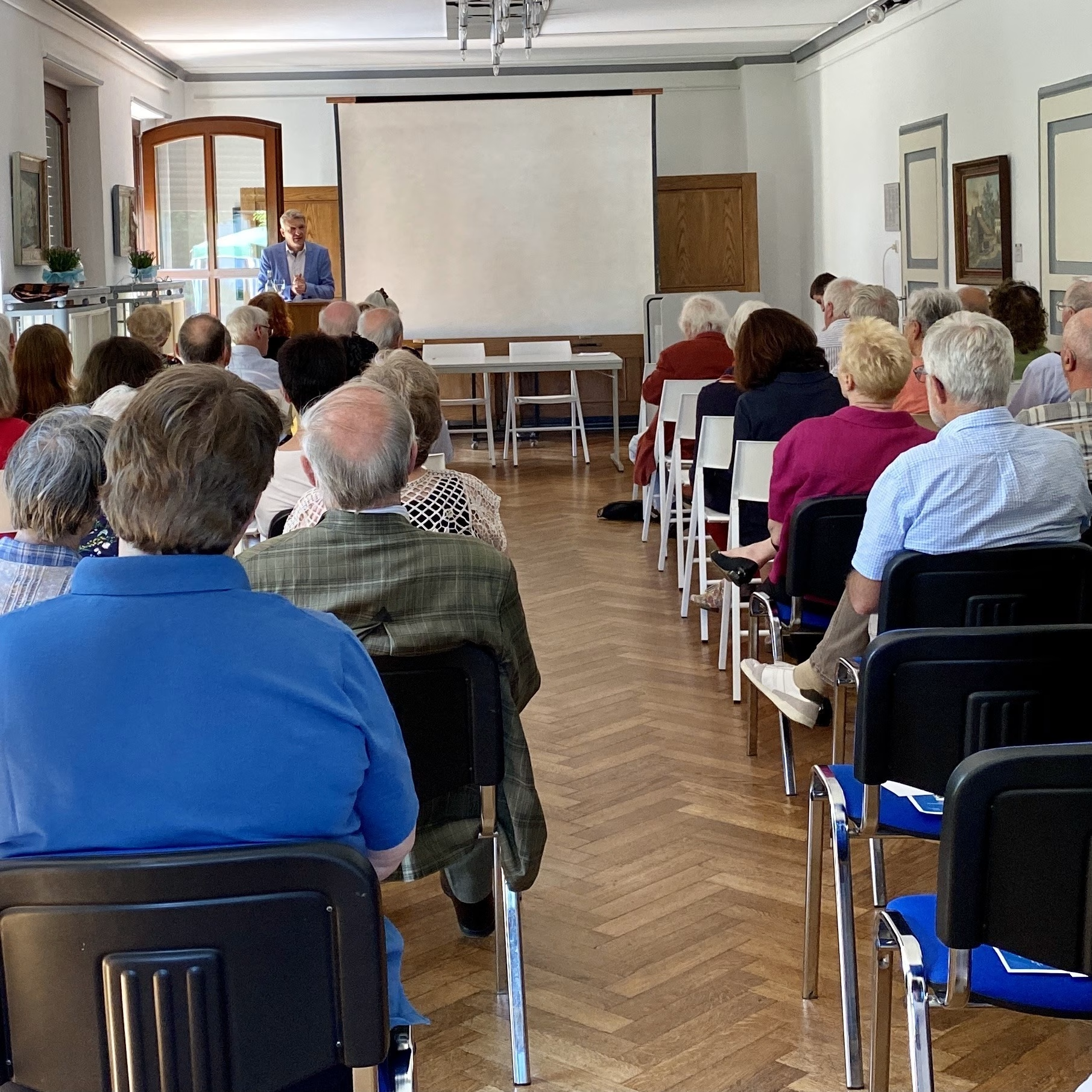
The Biosphere VHS St. Ingbert and the Université Populaire Transfrontalière Forbach organized a joint afternoon at the St. Ingbert Culture House, focusing on the France strategy, joint activities, multilingualism, and cultural exchange.
“Let this time never return, and never again let hatred destroy the world: There are people I love living in Göttingen, in Göttingen. But if weapons were to speak again, it would break my heart. Who knows what would then remain of Göttingen, of Göttingen” – these are two verses from the famous chanson by the French chansonnière Barbara, with which the sociable afternoon was opened. Written in 1964, they are more relevant today than ever. “Peace can only be created through friendships,” emphasizes Mayor Dr. Ulli Meyer in his greeting message for the German-French meeting, which gains special significance against the backdrop of current crises. About 60 participants from France and Germany had gathered in the cultural center – meeting in person and exchanging ideas beyond national borders is especially important to people after the Corona pandemic.
Link between France and Germany
“La Saare is the link between France and Germany” – the Saarland is the connection between France and Germany, as state parliament member Stephan Toscani explains regarding the Saarland’s France strategy. With Saarbrücken as the capital located directly on the border, the Saarland differs from other border regions. Thanks to bilingual education in schools, a close partnership between the economy and universities, and numerous cultural initiatives, cross-border cooperation is genuinely practiced and continuously expanded. Unfortunately, this was not always the case in history, as Emeritus of Political Science Prof. Dr. Adolf Kimmel explained in his lecture on the development from hereditary enmity to good neighborliness. This good neighborhood and friendship is promoted by many initiatives, including the “Association for the Promotion of Bilingualism in Saar-Lor-Lux,” whose chairman Dr. Wolfgang Bufe is very committed to multilingualism in education and leisure. As his tandem partner, Leon Dietsch presented the “L’association Culture et bilinguisme de Lorraine,” which also advocates for German as a language of instruction and initiates and supports multilingual cultural activities. The president of the Association of Saarland Adult Education Centers, Doris Pack, vividly illustrated cultural nuances in France and Germany in her contribution “Franco-German Cultural Relations. A Slightly Different Perspective.”
Multilingualism and Exchange in Business, Culture, and Education
Multilingualism is – alongside the fields of business, culture, and education – one of the cornerstones for successful exchange. However, this was not only discussed in theory. The entire afternoon was accompanied by various music, poetry, and theater performances in German and French. Lived friendship and active exchange – the topic was discussed in a cheerful back-and-forth between German and French under beautiful sunshine in the garden of the cultural center, lovingly called "Petit Versailles." This natural "language mix" is also a special feature that can hardly be found anywhere but in the Saarland.
A special thanks for this successful afternoon goes to Marika Flierl, head of the Biosphere Adult Education Center St. Ingbert, Christa Strobel, volunteer head of the VHS branches Hassel and Rohrbach, as well as Rose-Marie Tonnelier from the Université Populaire Transfrontalière Forbach, for the preparation and organization of the event. The aforementioned speakers and contributors, Mathias Abbing, Jürgen Bost, Ursula Ochs-Steinfeld, Albrecht Ochs, Rose-Marie Tonnelier, as well as the children and young people from the St. Ingbert Music School, brought the theoretical presentations to life with their contributions. Many thanks for that. Thanks also to the dedicated team of VHS St. Ingbert, Claudia Pfaff, Natascha Tselios-Politz, Heike Reckel, Elke Walgert, Martin Wörner, and Daniel Schwab for the organization and technical support.
