

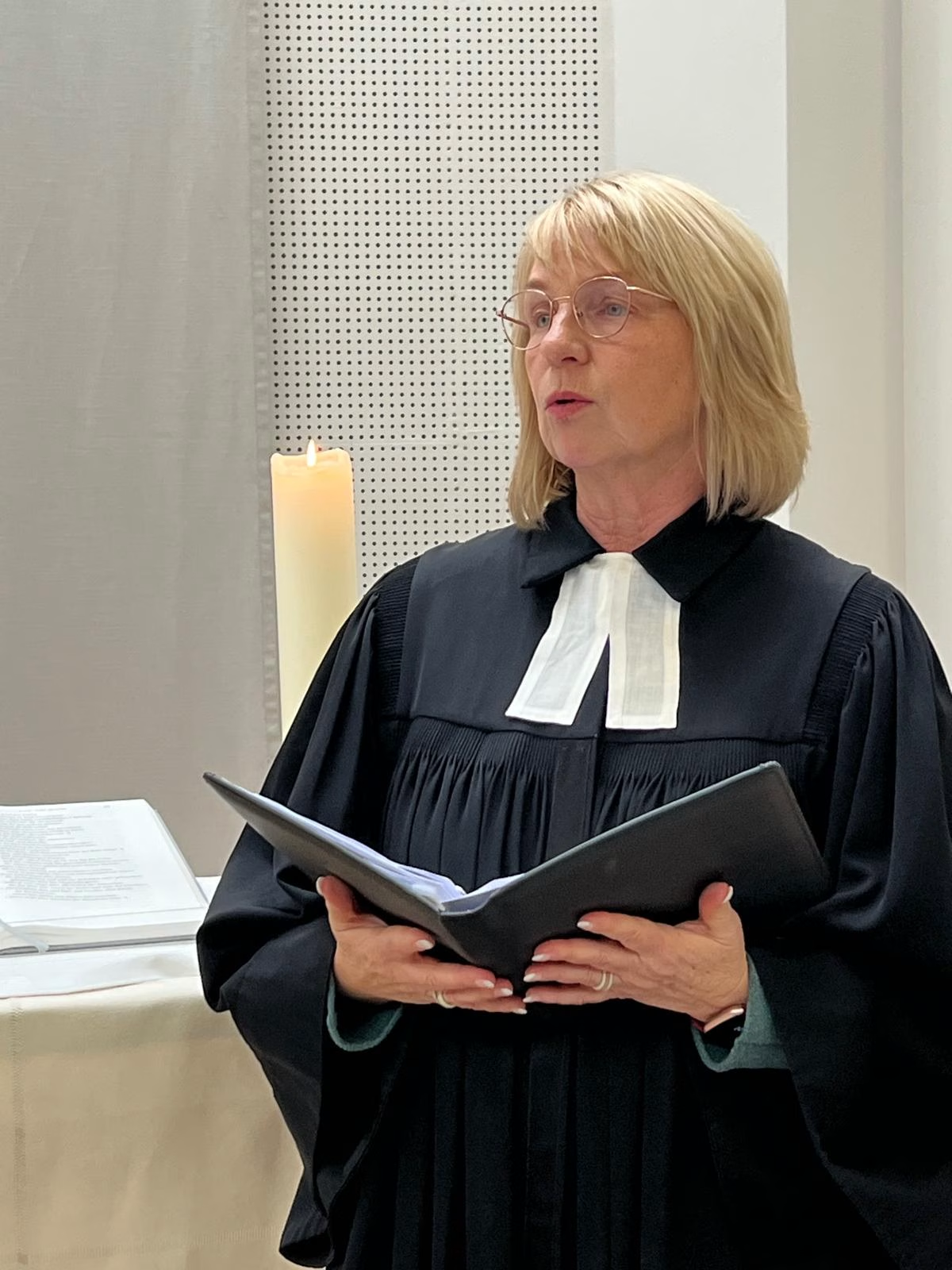
Actually, the Evangelical Church and faith have always held an important place in her life. Regular attendance at church services was simply part of it. Originally from Berschweiler, her wedding with a move to Marpingen in 1989 was, however, a significant step for her in spiritual terms. "Although the two places are only three kilometers apart, I suddenly found myself in a different parish and in a different church district," she recalls. At that time, the border between the former church districts of St. Wendel and Ottweiler ran between the two places. This shift from the Dirmingen parish to St. Wendel was difficult for her because many things were unfamiliar.
Zägel considered converting and going back "home," but ultimately decided against it. The decisive factor was the book "The Will of God," which she read during that time and which led her to the conclusion that the change might also be willed by God. She embraced the new challenge and volunteered in her new church community, becoming a board member for the Marpingen parish district in 2000.
It was very important to her to provide local Protestant Christians with a spiritual home. They were very grateful for the ecumenical connections with the Catholic parish of Maria Himmelfahrt, Zägel said, which initially provided spaces for the Protestant services. Later, they were guests of the municipal community of Marpingen, in the cultural center "Alte Mühle." In Marpingen, Zägel also became acquainted with the ecumenical Focolare Movement within the Catholic Church. The spirituality of this movement, especially the meaningful biblical phrase "Where two or three are gathered in my name, there am I among them" (Mt. 18:19-20), on which the church is lived without having a church building, influenced her and helped her in many ways. "An investment of the heart instead of money, a church of the future," she describes her lived experience. From this attitude, local community life has steadily grown.
In 2013, it gave her the opportunity to take on a position as a community assistant, which the St. Wendel church congregation had established. From then on, she continued her work full-time, built networks, promoted volunteering, and did much more. For the trained retail saleswoman, who most recently held the branch management of a supermarket in Marpingen, this was a chance to turn her heartfelt concern into her main profession. In 2015, additional tasks in refugee assistance were added. Through the "excellent cooperation" with the youth café 'idee.on', the municipality, and the Catholic Church, it was possible to welcome refugees and give them a home.
At that time, the then St. Wendel pastor and superintendent Gerhard Koepke asked if she could imagine training to become a lay preacher. But "I wasn't ready for that yet," Zägel said in retrospect. Instead, she completed a qualification course as a hospice companion. There, she was close to the people.
Her decision to pursue training as a lay preacher later on was the result of a maturation process, according to Zägel. Over the years, she had lovingly prepared many church services for Marpingen but was unable to conduct them without spiritual support. Additionally, dying individuals often expressed the desire to receive communion during her visits. However, she was not yet able to fulfill this wish without the proper authorization. Another impetus came from her parish pastor Christine Unrath. With the new lectionary system introduced in 2017, a lector group was formed in the church community, accompanied by her pastor. Through this group, she became more confident in the liturgy, Zägel said, because: “Everyone says, ‘Go ahead,’ but you also need to be shown how.”
All this led Bärbel Zägel to decide in 2022 to undertake the lay preacher training. The presbytery gave its approval, and Pastor Christine Unrath became her mentor. During the preparation, various courses must be taken at the Theological University in Wuppertal and in Nümbrecht, and ten church services must be created and conducted, accompanied by the mentor.
However, in the middle of her training period, professional changes occurred. In December 2023, Bärbel Zägel left St. Wendel and became an employee in the parish office of the Protestant Church Community Malstatt, where she successfully completed her preparation in September of this year. Her ordination, which will now take place on the first Sunday of Advent, marks the official conclusion. With it, the 59-year-old is authorized to independently perform church official acts. This means she is allowed, for example, to conduct baptisms and funerals – and of course, to celebrate worship services.
In the future, Bärbel Zägel will support the spiritual team of the Malstatt church community. Being a lay preacher is a voluntary position. “In volunteering, I enjoy inner freedom. This freedom creates creativity for the gospel in my preaching ministry. I want to preserve that,” she emphasizes. “This is another new step for me to help shape the church together with many others.”
Info:
Bärbel Zägel will be ordained during a church service on the 1st Sunday of Advent, Sunday, December 1, at 2 p.m. in the Protestant Community Center Knappenroth (Im Knappenroth 1) in Malstatt. Afterwards, all guests are invited to coffee and cake.
Background:
In the Evangelical Church in the Rhineland (EKiR), volunteers and professional employees can be ordained and appointed to the office of preacher after regional church preparatory courses.
In addition to the gift of preaching, lay preachers should have a sufficient general education and biblical knowledge, as well as an understanding of theological issues and have proven themselves in church life.
Until early 2004, they were called "preaching assistants" in the EKiR, but today the term lay preacher is used. They come from all age groups, professions, and social backgrounds. In carrying out their preaching duties, they wear the clerical gown just like pastors.
In the Saarland, there are currently 35 active lay preachers in the church district association An der Saar.
