

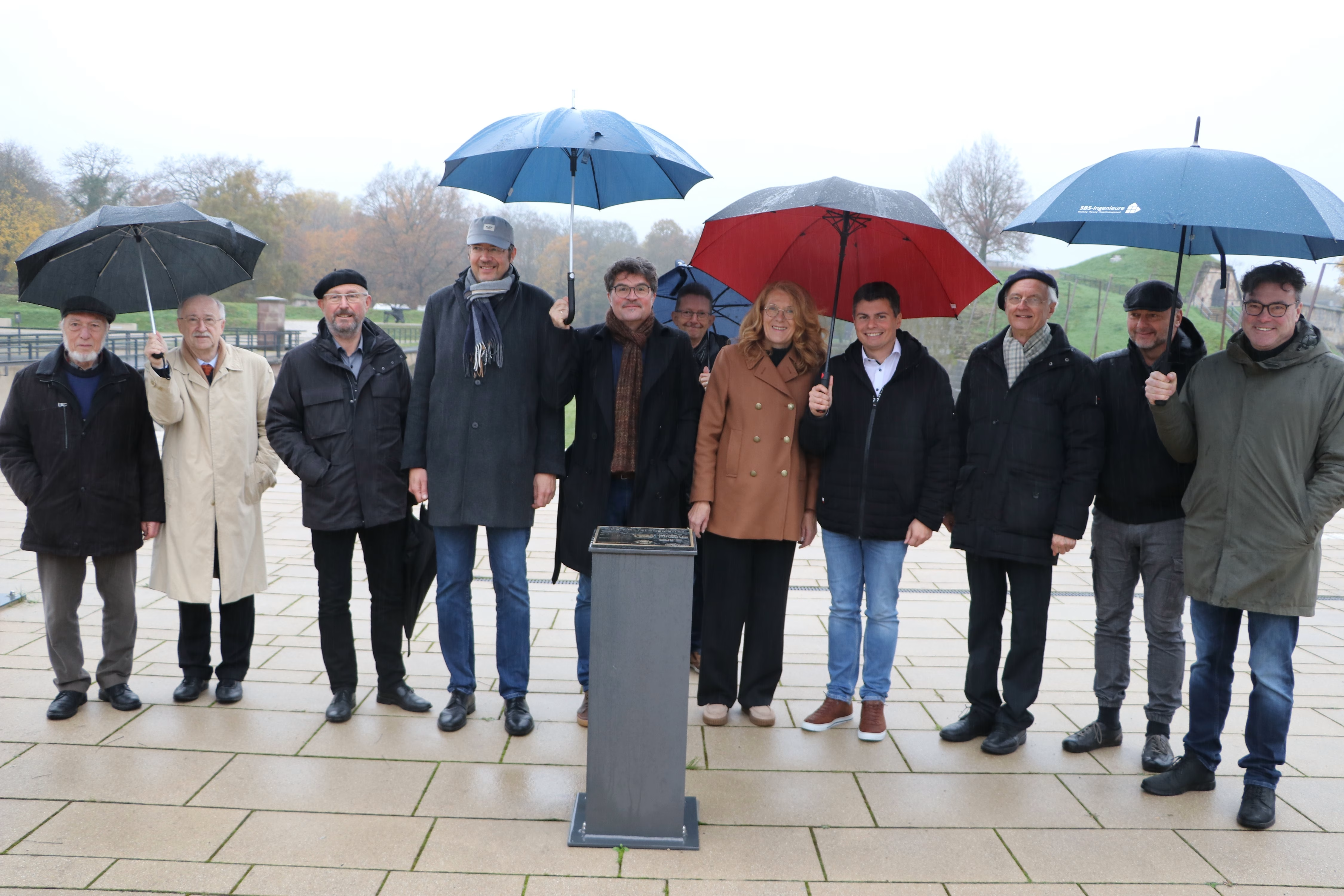
Minister Berg on the importance of reference points: "GPS receivers enable an exact determination of the position on the Earth's surface. In private use, they are used as navigation aids on foot or by bike, for positioning photos and videos, or for geocaching. When you need to get help quickly in an emergency, knowing the exact location is often very helpful. Conventional GPS receivers usually achieve an accuracy between three and 20 meters. With GPS reference points, the accuracy of these receivers can be verified."
“With the establishment of the reference point at Roland-Henz-Platz in the area of Ravelin V, we not only want to promote the accuracy of GPS data. The historically valuable square is also a starting point for many city tours and attracts numerous visitors. Now visitors and residents of the city can orient themselves using the existing tactile model and calibrate their smartphones with exact reference right next door for further explorations of the city,” emphasizes the deputy mayor of the Saarlouis district town, Gerald Purucker.
"The establishment of this reference point is an important contribution to better orientation in Saarlouis," explains Stefan Bost, current president of the Lions Club Saarlouis. "My thanks go to our former president Prof. Dr. Dieter Bohr, who significantly supported the implementation of this project and the tactile model for the visually impaired during and after his term of office. This way, both visitors to the city and visually impaired people can benefit from the improved orientation options."
For positioning, the signal from navigation satellites is used. At least four satellites must be received simultaneously for reliable positioning. Until now, navigation receivers have almost always relied on the signal from the American Global Positioning System (GPS). With the Russian GLONASS and the European GALILEO project, additional satellites are added, making positioning more reliable, faster, and more accurate. To provide the possibility to verify the accuracy of a receiver, the GPS reference point was established. This was determined with centimeter precision in terms of location and height using the Satellite Positioning Service of the German national surveying authority (SAPOS) and a precise geodetic GNSS receiver.
For more information on how the GPS reference point works, please refer to the attached flyer.
