

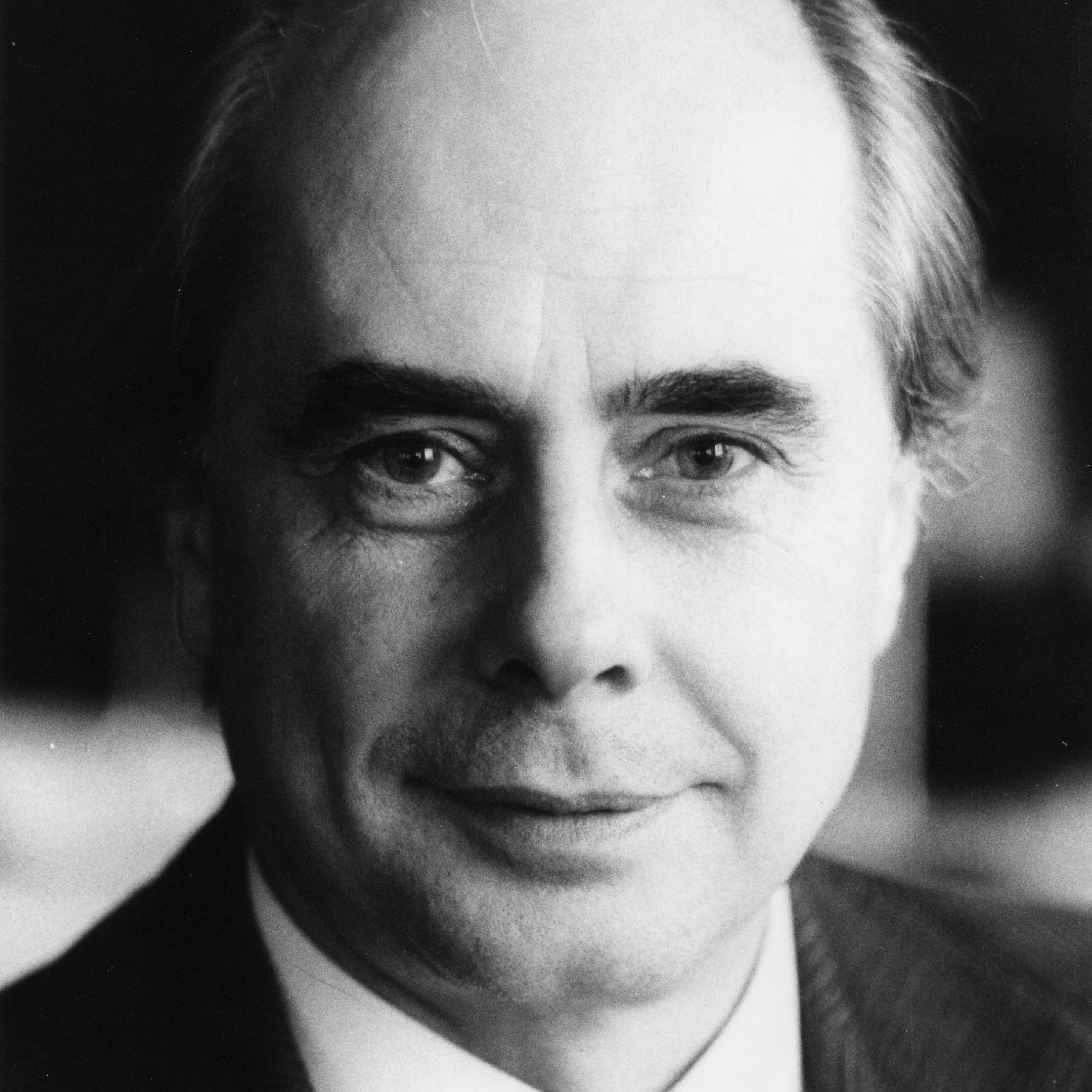
Dr. Werner Hellenthal, who served as mayor from 1971 to 1984, provided essential impetus for the development of St. Ingbert during this time. Under his leadership, numerous urban planning and economic projects were initiated that left a lasting mark on the city. The law graduate was a member of the St. Ingbert city council from 1960 to 1974 and a member of the CDU party. During his time on the city council, he also served as First Deputy Mayor from 1960 to 1964. In 1971, in view of the upcoming municipal territorial and administrative reform, the city council appointed him as commissioner for the office of mayor. In this position, he prepared the territorial and administrative reform with the incorporation of Rohrbach, Hassel, Oberwürzbach, and Rentrisch. On July 4, 1974, he took office as the first mayor of the new mid-sized city of St. Ingbert. Until July 4, 1984, he energetically and effectively led the affairs of the mid-sized city.
As mayor, his special focus was on modernizing the city’s infrastructure as well as the cultural development of St. Ingbert. At times a contentious character, yet never losing sight of the city’s interests. Even after his term of office, Dr. Hellenthal remained an important figure in the city’s life and was involved in various areas of public life.
Today is not only an opportunity to remember him but also to honor his legacy, which is still visible in many parts of the city. His visionary decisions and dedication have shaped St. Ingbert in many ways and made it what it is today.
“With Dr. Werner Hellenthal, the city commemorates an outstanding personality who acted with foresight and commitment. He was a dedicated advocate for the interests of St. Ingbert, who played a key role in the transformation of the city in the 60s, 70s, and 80s and shaped the cityscape,” praised Mayor Prof. Dr. Ulli Meyer the work of Hellenthal.
During his political career, he was passionately committed to the concerns of St. Ingbert. As a city councilor and later mayor, he advanced the development of the city center around the marketplace, which became visible through the construction of the town hall, the fire station, as well as the Ingobertus and city halls. These projects reflect a modern urban development of that time.
