

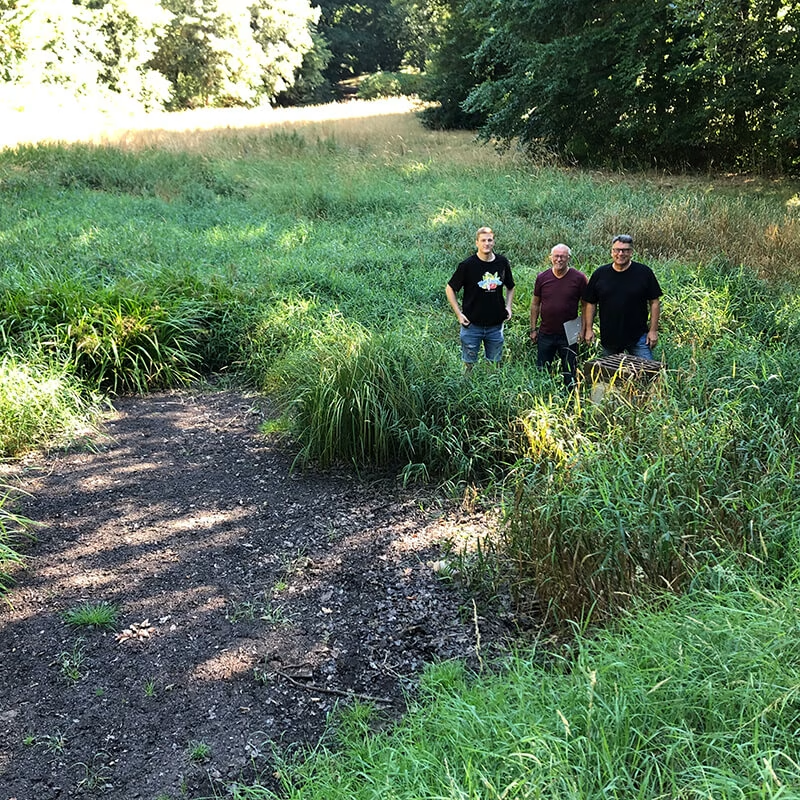
“With simple, relatively cost-effective measures, a lot can be achieved during heavy rainfall,” explains Gerd Lang, Head of the Waters and Flood Protection Unit. The topics of heavy rain and flooding have concerned both citizens and the city administration even more since the disaster in the Ahr Valley. As a result, natural spots are being sought throughout the city where runoff water can infiltrate. The best example is the street ‘An der Kohldell.’ During heavy rainfall, water flows down from the forest cemetery at its lowest point and, in the worst case, floods the basements of the adjacent houses.
To contain this danger, a first natural depression on the forest path was equipped with throttle flaps so that water can accumulate here a little longer. A few meters below, a drainage pipe was laid from the forest under the path into a second depression, which collects and allows the water to seep away. And in the cemetery parking lot, a green strip was converted into a retention basin: curb pieces were lowered and the depression was throttled so that water can also collect and seep here. At the edge of the parking lot by the road, citizens and passersby are quite surprised by an unusual, approximately 50-centimeter-wide lowering of the curb – this allows water to flow towards the basin. Simple but ingenious ways to gradually channel water into natural basins where it can infiltrate. The three depressions hold a total of about 7,000 cubic meters of water – the houses located in the "valley" are thus already protected.
“Complete protection against heavy rain is not possible because the timing, location, and amount are simply unpredictable,” explains Markus Schmitt, Deputy for Sustainable Urban Development. However, St. Ingbert uses its geographical conditions to relieve citizens as much as possible, Schmitt says. Similar retention basins already exist at Kleberweiher, on the street ‘An der Kolonie,’ and in Betzental between the parking lot and the highway. There are also other options: In close contact with the highway company and forestry operations, he is looking for additional infiltration basins in the South Street and Oberwürzbach areas. “And in the city center, the Gustav-Clauss-Anlage now functions as a large retention basin with a volume of 25,000 cubic meters by raising the backwater level,” he adds.
Over time, a system will be created that relieves citizens through the combination of flood level sensors on the St. Ingbert streams, a heavy rain map currently under development, and the existing and new retention basins. Nevertheless, all citizens and homeowners are also encouraged to look for ways to infiltrate water on their own properties and implement these measures. This includes as large infiltration areas as possible in the garden, downspouts leading into a cistern or rain barrel, and terrain modifications that can prevent or delay water ingress at known weak points.
