

Glass production was an important economic factor in St. Ingbert alongside the mine and the ironworks. At the beginning of the twentieth century, men and women in six glassworks mainly produced bottles as well as window and sheet glass. Shortly after the First World War, St. Ingbert was considered the center of the entire southwestern German glass industry. When sales opportunities declined in Germany and France after the war, distribution initially expanded worldwide. However, the glassworks soon became uncompetitive and were gradually closed down. The last to close was the St. Ingbert glassworks of the United Vopelius and Wentzel glassworks, newly built in 1918, which was shut down in 1975.
A treasure from a private collection
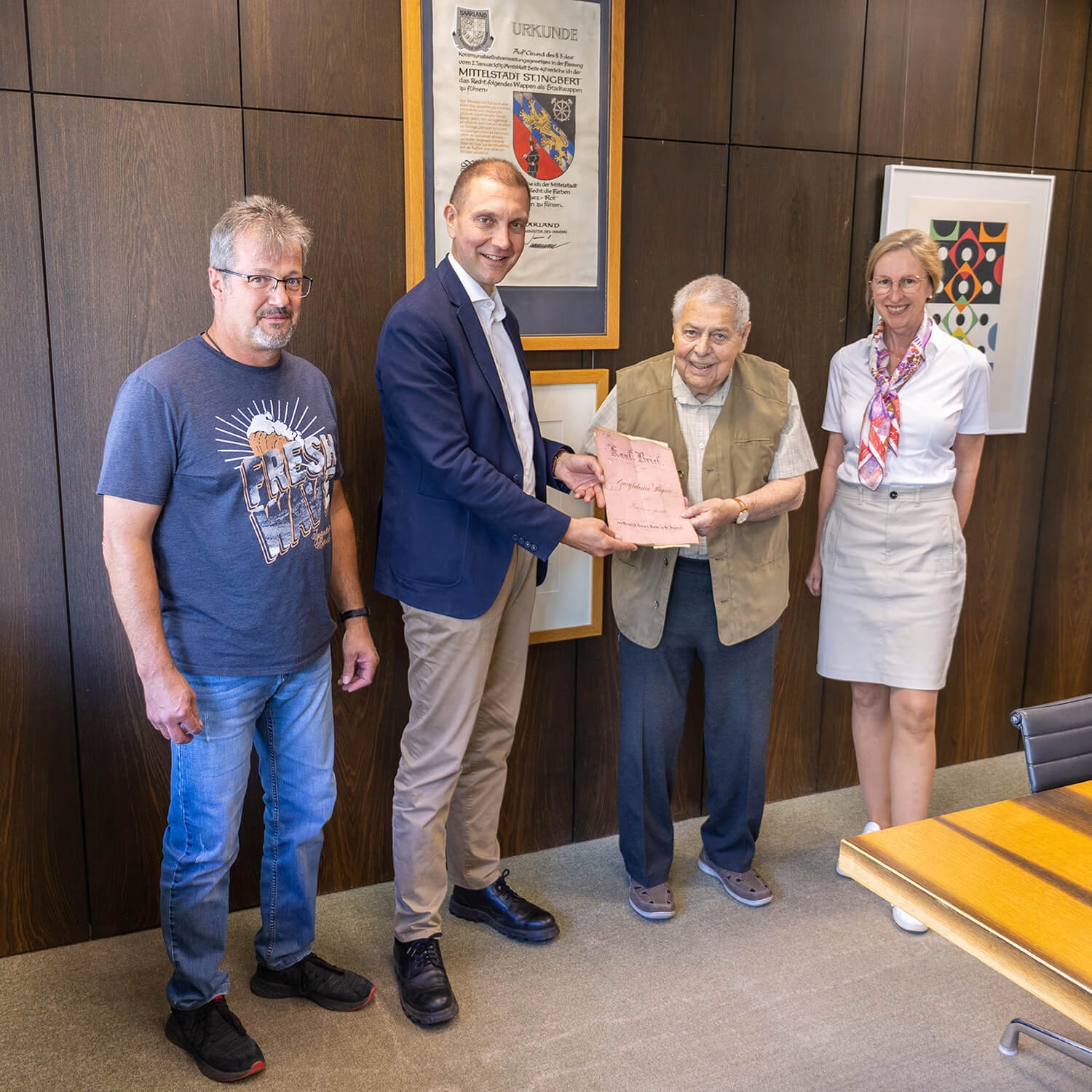
A special testament to this long-past era was recently found in the cabinets of former city council member Manfred Barth, son of the St. Ingbert local historian Hermann Peter Barth (*1905, ✝1965). Hermann Peter Barth had already left a comprehensive legacy of his research work to the city archive during his lifetime. Now, his son has discovered another historically significant document in his father's remaining papers – a purchase contract for the Rohrbacher Glassworks from 1854. He is donating this valuable document to the city archive as a gift.
“This purchase agreement is a small but very interesting building block in the history of St. Ingbert,” says Heidemarie Ertle, head of the city archive. “It is always astonishing how many ‘treasures’ lie dormant in private collections. Since they usually have sentimental value to their owners, it is all the more appreciated when they make them available to us.”
The Rohrbach Glassworks
According to research by local historian Karl Abel, the Rohrbacher Glassworks was founded by Johannes Weigand in the mid-eighteenth century. It produced utility glass, but the operation was not profitable as it fired with wood, unlike other glassworks. The glassworks was auctioned off due to excessive debts, but its successor, Jakob Stenger, also went bankrupt. The building gradually fell into disrepair and production was discontinued around 1754. Several unsuccessful owners followed until the business was taken over by the Hussong-Riesch family. Even then, major commercial success was slow to come until around 1900 when the entire site, including houses, outbuildings, meadows, and fields, was acquired by Ludwig Pauly, who further expanded it by purchasing additional land. “Almost the entire Glashütter Valley up to the Glashütter Dell, where today’s Edelweißhütte stands, belonged to the Paulys at that time,” as can be read at https://t1p.de/8motp (accessed: 21.07.2022). This also included the property of Peter Rau, on whose land a farm with stables and sheds was located (today’s parking area at Glashütterhof), for which Rau had a tavern license. The farm became the first inn at Glashütterhof. After several changes of ownership, in 1963 the Denne family (today Dumont) took over the inn, which still welcomes its guests today under the name “Restaurant zur Rohrbacher Glashütte” with traditional German cuisine and new ideas (https://www.rohrbacher-glashuette.de).
