

Although the expansion of broadband in rural areas is gradually gaining momentum, it still lags behind in some places. This became particularly noticeable during the increased mobile work with home office and homeschooling due to the coronavirus. Additionally, higher data volumes are now common, as television and telecommunications are largely provided via the Internet. During peak times, data networks are often heavily loaded. Inadequate digital connectivity means significant competitive disadvantages for companies and the self-employed and thus missed future opportunities for the region. Even smaller companies, such as engineering firms, need to be able to transmit or receive large data packages nowadays. Therefore, the availability of fast internet plays an increasingly crucial role in location decisions for many businesses. According to the Basic Law, the expansion of communication networks is organized by private companies. However, if no companies undertake the expansion, the state can step in. The so-called Federal Broadband Expansion Program offers new opportunities for comprehensive network expansion. In fiber optic networks, data is transmitted via optical signals and travels at almost the speed of light through the cables. This already allows speeds of up to 1 Gbit/s today, and even significantly higher data rates will be possible in the future, as fiber optic technology provides the necessary broadband capacities.
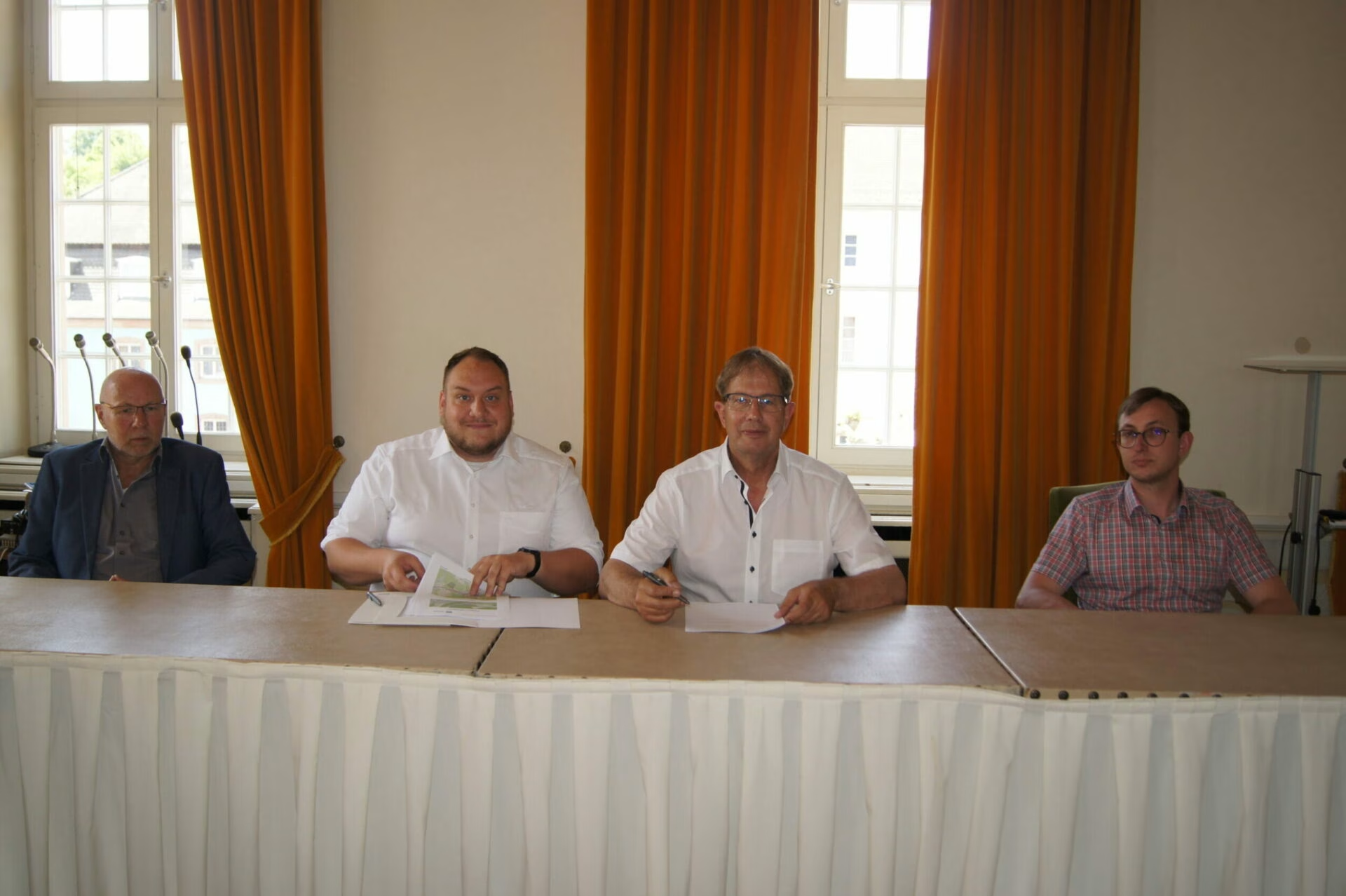
There is still room for improvement in the districts of Blieskastel as well. "The cooperation now concluded between the city administration and Deutsche Glasfaser Wholesale GmbH is intended to effectively counter this situation," said Mayor Bernd Hertzler about the current development. "The company, a fusion of 'Deutsche Glasfaser' and the already active company Inexio in the city of Blieskastel, has already concluded cooperation agreements with most Saarland municipalities for the construction of fiber optic networks."
The coming weeks will now be crucial regarding the demand and implementation of the planned fiber optic network. Shortly, all residents will receive further information in writing. If a positive response with signed preliminary contracts from about 40 percent of households is achieved across the entire expansion area, all polygons in the contract area will be developed, regardless of whether the minimum threshold was reached in each individual polygon. Only in cases of extremely low positive feedback could expansion be omitted on a case-by-case basis. The spatial scope of the agreement area currently includes the districts of Alschbach, Aßweiler, Ballweiler, Lautzkirchen, Bierbach, Biesingen, Blickweiler, Blieskastel, Breitfurt, Mimbach, Niederwürzbach, Seelbach, Webenheim, as well as the commercial areas Auf Scharlen, Aßweiler, Blieskastel-Blickweilerstraße, Industriering, Breitfurt, and Niederwürzbach. The planned expansion refers to all streets within each district. Excluded from the "deal" are Böckweiler, Altheim, Pinningen, Brenschelbach (including the station and Riesweiler). According to Deutsche Glasfaser Wholesale GmbH, expansion here would be very uneconomical. Mayor Bernd Hertzler intends to try to provide relief nonetheless: "The city administration's plans now foresee strengthening the internet connection in these parts of Blieskastel through subsidies from the state and applying for corresponding funds from the Rural Development program for upgrades," explains the head of the administration. However, there is already positive news regarding mobile network coverage – Brenschelbach is expected to receive two new cell towers with 4G or even 5G connectivity in the near future – serving both Telekom and Vodafone recipients. And possibly a new cell tower might also be built between Böckweiler and Pinningen.
The current costs for a fiber optic connection are already specified by Deutsche Glasfaser: When signing a preliminary contract within the framework of the currently ongoing market exploration or until the actual start of construction, the house connection will be provided free of charge; afterwards, it costs a one-time fee of €750 gross. By ordering early, private customers thus save the connection fee. The monthly tariff costs are then divided into four speed options: 300 Mbit/s (€44.95/month), 400 Mbit/s (€49.95/month), 600 Mbit/s (€79.95/month), and 1000 Mbit/s (€89.95/month), with a mobile flat rate partially included in some tariffs. In the first year of use, the costs for all tariffs amount to €24.95 per month; an additional €15 is charged for HD TV reception. The internet TV package offers a large selection of channels, accessible via TV, browser, or app on smartphones and tablets. However, it can take about 2-3 years until all construction work is completed. (ub)
